
PART 2
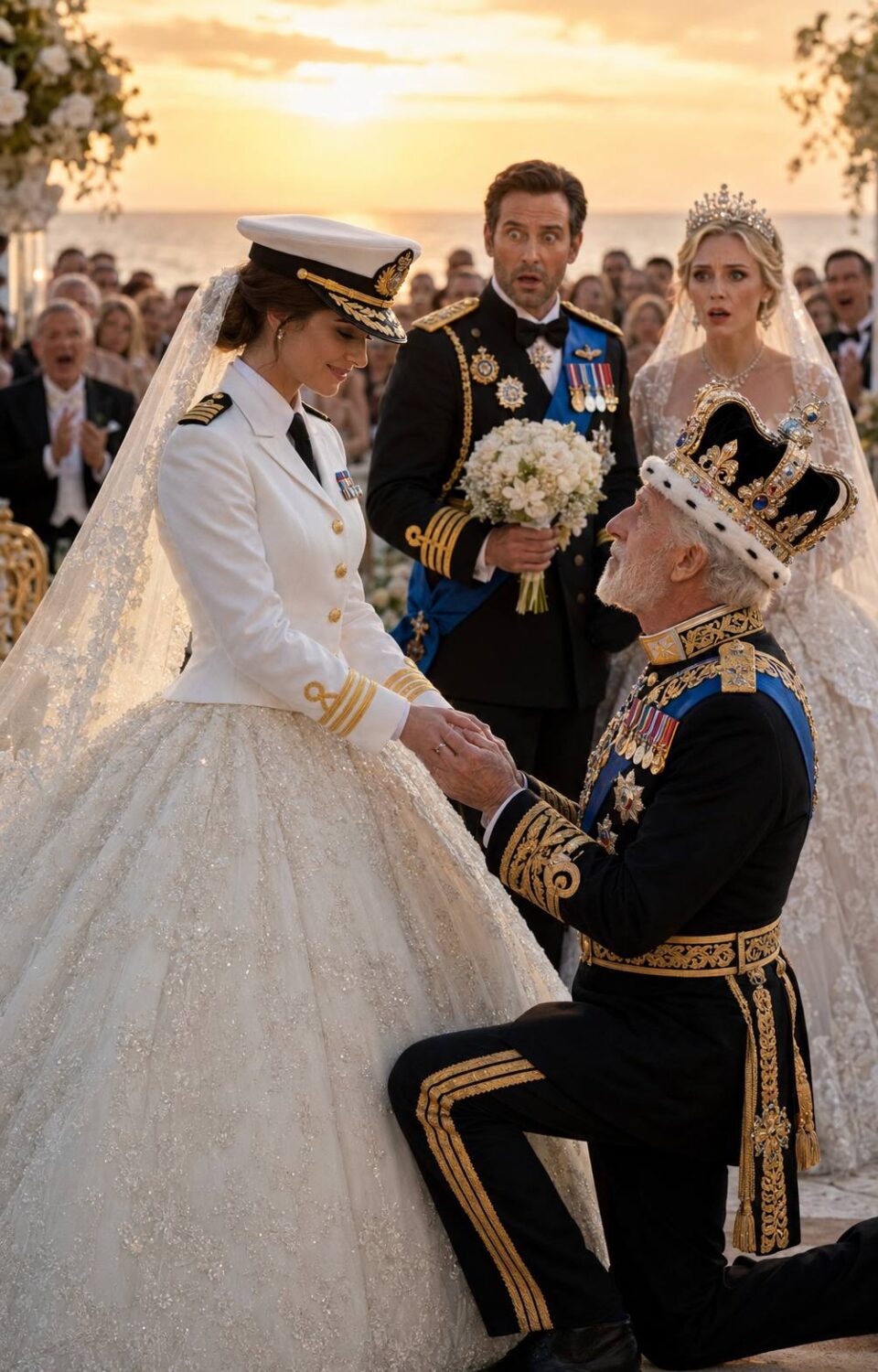
“Before this ceremony continues,” the king declared firmly, “your sister has the right to know why you sent a letter in her name declining our invitation.”
I could even hear the faint sound of Rachel’s fingers tightening nervously around her bouquet.
For several seconds, I stood completely still, convinced I must have misunderstood.
A letter of refusal?
Written in my name?
I looked at the sovereign, then at Rachel, and finally at Prince Alexander. His face, calm only moments earlier, had become rigid beneath the golden glow of the grand chandeliers.
Around us, the guests began exchanging glances and whispers. Their murmurs drifted through the chapel like a current of air.
Rachel parted her lips.
She was still beautiful.
Maybe that was exactly what made the scene so difficult to accept.
Standing beneath an arch decorated with white roses, a diamond necklace around her throat and a long veil flowing delicately behind her shoulders, she looked like the same girl who had spent her entire life winning people’s trust before anyone ever thought to ask her questions.
“I don’t understand what you’re referring to, Your Majesty,” she said.
Her voice trembled slightly.
It was an almost perfect display of vulnerability.
But the king showed no hesitation.
“You understand very well,” he replied.
Another murmur swept through the room.
I was still standing in the center of the aisle, wrapped in my blue ceremonial uniform.
Strangely, I felt more exposed there than I had in many situations during my service.
My perfectly polished shoes reflected the candle flames. My ribbons and decorations were arranged neatly across my chest. A ceremonial sword hung at my side.
An important symbol, but completely useless against what was happening.
“Your Majesty,” Prince Alexander suddenly interrupted, “this is my wedding day.”
The king looked at him.
“A wedding that was in danger of being built on a serious lie.”
Alexander took a slight step back.
Rachel immediately turned toward him.
“Alex, please. I don’t know what’s happening. I swear.”
The sovereign raised one hand.
From the side of the chapel, a man in an elegant dark suit stepped forward. In his hands, he carried a leather folder decorated with the royal crest.
I recognized him immediately.
He was the royal secretary who had traveled with me to the palace. During the entire journey, he had remained almost completely silent, doing little more than watching me with an attentive, tired gaze.
“Commander Carter,” the king said, addressing me in a calmer tone, “three months after the day you saved my life, the palace sent you an official invitation.”
I frowned.
“An invitation for what?”
Even my own voice sounded distant.
“To come here,” he explained. “I wanted to receive you personally. The royal family wished to publicly recognize your actions. Furthermore, if you had been interested, we intended to offer you a position as a naval liaison officer to our maritime council.”
It took me several moments to truly understand those words.
My mind returned to the months after the evacuation.
I had come home exhausted, injured, and required to remain silent about much of what had happened.
At the time, our mother was ill.
Rachel was organizing charity events, fundraisers, and public gatherings. She constantly talked about the need to build, as she put it, “a life that truly meant something.”
Mail often piled up on the table at home.
I remembered some of the envelopes.
I also remembered how they would suddenly disappear.
Every time, Rachel assured me she had taken care of everything.
“I never received that invitation,” I said slowly.
“Exactly,” the king replied. “Because the palace received a response signed with your name.”
The secretary opened the folder.
He removed a sheet of paper and handed it to the sovereign.
The king, however, did not begin reading immediately.
First, he turned his gaze toward Rachel.
It seemed as though he wanted to give her one final opportunity to speak voluntarily.
She remained silent.
Then the sovereign read the document.
“With gratitude for His Majesty’s generous invitation, I must decline all recognition and request that no further attempts at contact be made. My actions were solely part of my professional duty, and I do not wish to be publicly associated with the Kingdom of Velaris or the royal family.”
My throat tightened.
It was a polite letter.
Formal.
Carefully written.
And completely false.
“I did not write those words,” I declared.
“We know,” the king replied.
Rachel’s face had turned pale beneath her bridal makeup.
Still, she quickly regained control.
She let out a short, disbelieving laugh.
“This is ridiculous. Anyone could have sent a letter like that.”
“Certainly,” the king said. “Provided that person had access to your sister’s private documents, her signature, and her previous military correspondence.”
The entire chapel seemed to turn toward Rachel at the same time.
She slowly shook her head.
“No.”
The royal secretary stepped forward again.
“The paper used for the letter matches stationery purchased in Virginia by Ms. Rachel Carter. The signature was reproduced using old medical documents signed by Commander Carter. Furthermore, the postage was charged to an account connected to Ms. Carter’s event-planning business.”
Rachel’s hands lowered slightly.
Even the bouquet seemed to bend beneath the pressure of her fingers.
Alexander watched her in silence.
His expression was that of a man who suddenly no longer recognized the person standing before him.
“Rachel…” he murmured.
She turned quickly.
A flash of fear appeared in her eyes.
“Alex, listen to me. I can explain everything.”
“I believe that would be appropriate,” the king commented.
That was when I noticed the change.
It was almost imperceptible.
But I knew my sister too well.
The confused and vulnerable young bride disappeared.
In her place, I saw the Rachel I remembered from childhood.
The same girl who had once broken our mother’s favorite vase, hidden the pieces beneath my bed, and cried so convincingly that I had ended up feeling guilty.
Rachel lifted her chin.
“Fine,” she said. “Yes. I sent the letter.”
A wave of shock swept through the guests.
I felt my blood turn cold.
For the first time since the accusation began, Rachel looked directly at me.
“You were never there,” she said.
Her voice had changed.
Every word seemed sharpened.
“You were always away. Always the brave one. Always the one sacrificing everything. Mom kept your medals in the living room as if they were sacred objects. Every conversation ended with your name. Where Emma was. What Emma had been through. How strong Emma was.”
I almost laughed.
Not because anything was funny.
But because those words were nearly impossible to endure.
“Our mother was dying,” I replied.
“And she kept asking for you!” Rachel exploded. “Even when I was the one who was there. I paid the bills. I arranged the appointments. I took care of the house while you sent postcards and excuses no one could verify.”
The chapel began to feel distant.
I had been deployed.
I called whenever I could.
When I was granted emergency leave, I came home and slept for nine nights beside our mother’s hospital bed.
Then Rachel told me she could handle everything.
She accused me of attracting attention and sympathy from others.
Suddenly, I remembered her words.
And something inside me broke.
“You told me Mom didn’t want me to stay,” I said.
Rachel’s eyes changed.
For a moment, I saw something on her face.
Guilt.
It lasted barely a second.
Then it disappeared.
Prince Alexander moved away from her.
“How many other things have you lied about?” he asked.
Rachel opened her mouth.
No answer came.
The king spoke instead.
“Enough to force me to question every aspect of this engagement.”
Alexander turned toward his father.
“You knew all of this before today?”
“I had suspicions,” the sovereign replied. “The confirmation arrived this morning.”
Rachel grew even paler.
“This morning?”
The king looked in my direction.
“When Commander Carter’s neighbor contacted the palace.”
I immediately thought of Mrs. Alvarez.
She lived across the street.
That morning, she had stood on her porch in her bathrobe, pretending not to watch the royal guards outside my door.
Kind Mrs. Alvarez fed every stray cat in the neighborhood and seemed to know every piece of local news before sunset.
“She saw the guards?” I asked.
“She saw your sister leaving your house two weeks ago,” the king explained.
I was confused.
Rachel really had come to see me.
She had cried at my kitchen table.
She told me she was overwhelmed by the wedding preparations.
And she had asked for only one thing.
That I stay away.
According to her, my military career made Alexander uncomfortable.
The royal family, she added, preferred discreet people.
My presence might embarrass her.
And I had believed her.
Maybe because I was tired.
Maybe because some old wounds become so familiar that they begin to feel like truth.
“What did she tell the palace?” I asked.
The secretary removed another document.
“Mrs. Alvarez reported that after leaving your home, Rachel Carter threw several envelopes into a trash container near the curb. Believing they might contain official documents, Mrs. Alvarez retrieved them.”
Rachel muttered something under her breath.
I couldn’t understand the words.
The secretary continued.
“Among the envelopes were two still-sealed letters from the palace addressed to Commander Carter. One contained a new official invitation. The other was a personal message from His Majesty.”
The king’s expression softened.
“I had hoped to meet you again under very different circumstances,” he said. “Without scandal and without all this commotion. Your sister, however, continued to prevent it.”
Rachel looked around.
She was searching for someone.
A friend.
An ally.
Anyone willing to break the silence and defend her.
But the guests simply continued watching her.
There was no compassion in their eyes.
Only the silent curiosity people feel when they witness something collapsing in front of them.
Alexander clenched his jaw.
Then he looked at Rachel.
“You told me your sister refused to meet my family because she considered us beneath her.”
My heart seemed to stop in my chest.
“What did you just say?” I managed to ask.
Rachel closed her eyes.
Prince Alexander, however, did not look away from her.
“You told me Emma despised the royal family,” he continued, his voice now loud enough to reach every corner of the chapel. “You said she considered us nothing more than decorative figures, useless people supported by the kingdom. You also made me believe she refused to attend the wedding because she thought I was using you.”
I was speechless.
The absurdity of those accusations nearly stole my breath.
Before that day, I had never met Alexander.
I had never spoken to him.
I had never expressed a single opinion about him.
Rachel’s fingers tightened around the bouquet stems. Several white petals broke away from the roses and slowly fell onto the chapel floor.
“I was afraid,” she confessed.
Alexander let out a short laugh.
There was no amusement in the sound.
“Afraid of what?”
Rachel lifted her eyes.
She looked at me.
This time, I no longer saw the fragile bride.
I didn’t see the wounded sister.
There were no carefully practiced tears or prepared words.
The mask had finally fallen.
“I was afraid of coming second,” she said.
Those words did not need to echo through the chapel.
They reached me directly.
For years, I had believed Rachel was angry because of my absence.
I thought she hated my uniform.
My career.
The distance my service had created between me and our family.
Only then did I understand the truth.
Rachel did not hate the fact that I had left.
She hated that even when I was far away, part of me continued to be present.
In our mother’s photographs.
In the medals displayed in the living room.
In our relatives’ questions.
In their memories.
“I didn’t want you here,” Rachel continued. “Not because you might embarrass me.”
She took a deep breath.
“I didn’t want you here because you would attract attention. Like always.”
She stared at me.
“You walk into a room and people want to know your story. You don’t even have to try, Emma. That’s what I hate most.”
I could have answered her.
I had years of unspoken words inside me.
Sentences harsh enough to hurt her.
Truths capable of permanently destroying whatever remained of our relationship.
For a moment, I wanted to say everything.
Then I truly looked at her.
And I didn’t see an enemy.
I saw a woman who had spent so much time fearing she was invisible that she had tried to erase her own sister from her life.
That realization hurt more than anger.
The king slowly turned toward Alexander.
“My son,” he said, “the decision is yours. But I will not give my blessing to a marriage built on deception.”
Rachel dropped the bouquet.
She grabbed both of Alexander’s hands.
“Alex, please.”
Her voice broke.
“I love you.”
Alexander lowered his gaze to their intertwined hands.
For several endless seconds, no one moved.
Then he slowly freed his fingers from her grasp.
The pain on his face was unmistakable.
“I think you love what this life represents,” he said quietly. “The palace. The title. The people watching you.”
He raised his eyes.
“But I no longer know whether you ever truly loved me.”
Rachel’s face seemed to collapse.
At that moment, the great chapel doors opened.
Two royal guards entered.
Their weapons were not drawn.
They shouted no orders.
They simply walked down the aisle with the calm of men who knew the ceremony was already over.
Near the front row, the wedding planner suddenly burst into tears. She was still clutching her notepad and staring at the arch of white roses above the altar.
I looked at it too.
Only minutes earlier, I had thought it was beautiful.
Now it seemed too perfect.
Too white.
Almost artificial.
The king turned toward the guests.
“The ceremony is suspended.”
Those four words destroyed the last appearance of order.
The guests stood.
Whispers became heated conversations.
Camera flashes illuminated the chapel.
Someone in the back rows raised a phone to film the scene, but a guard discreetly motioned for them to lower the device.
Alexander crossed the aisle.
He passed Rachel without touching her.
Then he disappeared through a side door.
Rachel remained alone before the altar.
I should have felt satisfied.
The truth had come out.
My name had been cleared.
Everyone had finally seen what I had spent years trying to ignore.
Yet I felt no sense of victory.
I was simply tired.
“Emma.”
I turned.
It was the first time that entire day Rachel had said my name.
I looked at her in silence.
“Now you have everything,” she whispered. “Are you happy?”
That was when I realized she still didn’t understand.
Maybe she never would.
“I never wanted to have everything,” I replied.
My voice was calm.
“I only wanted you to stop taking things that didn’t belong to you.”
Her gaze hardened again.
But this time, tears still slid down her cheeks.
The guards did not have to escort her out.
Rachel descended the altar steps on her own.
Her long silk gown rustled around her ankles.
The diamonds continued to sparkle at her throat.
Every step she took was watched by the same people she had tried so desperately to impress.
When she reached me, she stopped.
For one brief moment, I no longer saw two adult women.
We were children again.
Two sisters standing in the hallway outside our mother’s bedroom.
Silent.
Listening to her breathing.
Both frightened.
Both alone.
Both convinced the other had been loved more.
Rachel leaned close to my ear.
“This isn’t over,” she whispered.
Then she continued toward the doors.
I did not turn to watch her leave.
Several hours later, I stood on one of the palace’s western balconies.
Evening had fallen over Velaris.
The sky was painted lavender and gold, with delicate shades of pink. Below me, the streets of the capital twisted between ancient stone buildings and small bell towers.
In the distance, beyond the cliffs, the sea caught the last rays of sunlight.
Everything was so peaceful.
No smoke.
No alarms.
No voices shouting orders through a damaged radio.
Only the distant sound of bells and the wind coming from the sea.
Behind me, the palace was still trying to recover from the scandal.
Staff moved through the marble corridors almost silently.
The royal press office prepared cautious statements.
Black cars left the main courtyard one after another.
Somewhere in the palace, Alexander was probably trying to accept the end of the future he had imagined.
I placed both hands on the railing.
My uniform suddenly felt heavy.
“Commander Carter.”
I knew that voice.
I turned.
The king stood in the balcony doorway.
In one hand, he held his cane.
In the other, he carried a small velvet case.
Without the throne, the guards, or the entire court surrounding him, he once again looked like the man I had met that night at sea.
Arthur.
The man I had dragged from the black water during a storm.
I could still remember his freezing fingers gripping mine.
His weak breathing.
And his stubborn determination to remain conscious.
“Your Majesty,” I said.
He made a dismissive gesture with one hand.
“Arthur,” he replied. “At least when we are alone.”
I wasn’t exactly sure how to respond.
So I remained silent.
The king approached and stopped beside me.
For several seconds, we watched the sea together.
“For three years,” he finally said, “I wondered why you rejected every attempt I made to thank you.”
“I didn’t reject them.”
“I know that now.”
The wind stirred the silver hair at his temples.
Then he opened the case.
Inside was a star-shaped medal.
At its center gleamed a deep sapphire surrounded by a thin ring of gold.
“The Order of Saint Mary,” he explained. “Velaris’s highest civilian honor.”
He smiled slightly.
“Normally, it is presented during a very long ceremony. There are speeches. Music. And, frankly, an excessive number of people forced to remain standing.”
I couldn’t help myself.
I smiled.
He removed the medal.
“I would like you to accept it now.”
I lowered my gaze toward the small star.
Part of me wanted to refuse.
I wanted to return to my old life.
A life where recognition came rarely.
A life of missions without photographs, names blacked out in reports, and operations no one would ever discuss.
I had learned to believe that survival was reward enough.
Then I thought of the letters thrown into the trash.
I thought of my mother’s fragile hands brushing over my medals.
I thought of every time I had lowered my voice, hidden my accomplishments, and made myself smaller to keep the peace.
I had always called that humility.
Maybe it had simply been fear.
I slowly bowed my head.
The king pinned the medal beneath my ribbons.
The sapphire caught the final ray of sunlight.
“Thank you, Emma,” he said.
I raised my eyes.
“For saving you?”
Arthur smiled.
“No.”
He gave a small nod toward the palace.
“For finally coming.”
Before I could answer, the balcony doors flew open.
The royal secretary appeared in the doorway.
His face was tense.
“Your Majesty.”
Arthur turned.
“What is it?”
The man hesitated.
Then he looked at me.
“We have a problem.”
I immediately felt an old instinct awaken.
The same instinct that, during a mission, warned me of danger before anyone even said the word.
“Rachel?” I asked.
The secretary shook his head.
“No.”
He stepped forward and handed me an envelope.
It was old.
The edges were worn.
On the front, I immediately recognized handwriting I had not seen in years.
My mother’s handwriting.
My heart began pounding again.
“Where did you find this?” I asked.
“Among the documents recovered from your sister’s house.”
I took the envelope.
My hands, which had never trembled during storms, evacuations, or missions under fire, suddenly refused to remain steady.
On the back were only five words.
FOR EMMA. ONLY AFTER MY DEATH.
I slowly raised my gaze.
Arthur watched me in silence.
I opened the envelope.
Inside, I found a photograph.
Two young women stood in front of the palace of Velaris.
One was my mother.
I recognized her smile immediately.
The other woman wore a small crown.
Turning the photograph over, I found a date.
Thirty-two years earlier.
And beneath the date, a sentence written by my mother:
Emma, if you are reading this, it means Rachel has finally discovered enough to become dangerous.
I stopped breathing.
I continued reading.
The next sentence changed everything.
King Arthur is not the first member of the royal family our family has saved.
The wind seemed to stop.
I looked at the king.
Arthur was staring at the photograph.
All color had drained from his face.
“You knew my mother?” I asked.
For the first time since I had met him, the king looked afraid.
“Emma,” he whispered.
Then he pointed to the crowned woman in the photograph.
“That was my sister.”
I felt the world tilt beneath my feet.
Arthur closed his eyes.
“And she died thirty years ago.”
He slowly opened them again.
“At least… that is what the kingdom has always believed.”
Clutching my mother’s letter between my fingers, I watched the lights of Velaris come alive one by one below us.
That morning, I thought I had been dragged to the palace to witness my sister’s wedding.
Then I discovered I had saved a king.
I watched years of lies collapse before an entire royal court.
I believed the story was finally over.
I was wrong.
Because Rachel had not only tried to erase my name.
She had found something our mother had hidden for thirty years.
Something connected to the royal family.
Something someone had already lied about.
And perhaps killed for.
I looked at the letter.
Then at the king.
“Arthur,” I said slowly, “I think we need to find my sister.”
In the distance, beyond the palace gates, a black car sped into the night.
And in the back seat, hidden from our eyes, Rachel clutched the second half of our mother’s letter in her hands.
The half containing the real name of the woman who could destroy the crown.
THE END… OR MAYBE ONLY THE BEGINNING.
