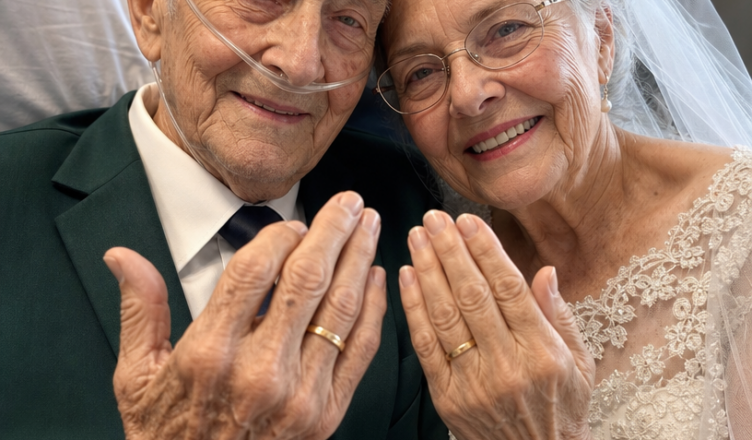
At seventy-three, I married my high school sweetheart because he told me it was the one dream he still hoped to fulfill.
The morning after his funeral, his attorney appeared at my door carrying a small box.
He looked directly at me and said something I would never forget.
“Thomas was right. You walked straight into his plan.”
I never expected to become a bride at my age.
Thomas had been my first love.
We were seventeen when we met, young enough to believe every decision would last forever and old enough to make choices that could change the rest of our lives.
I had earned a place at a college several hours away.
Thomas planned to remain in our hometown and work with his father.
At the bus station, on the morning I was supposed to leave, he held my hands and asked me to stay.
“Please, Nancy,” he said. “We can build a life here.”
Part of me wanted to say yes.
But I had worked for years to earn that opportunity.
My family had very little money, and college represented more than an education to me.
It represented independence.
A future.
A chance to become someone I had only imagined.
“I have to go,” I told him.
Thomas looked at me for a long time.
Then he released my hands.
“You’re choosing your future over us.”
I remember crying.
“I’m choosing the future I worked for.”
He shook his head.
“You broke my heart, Nancy.”
Those were the last words Thomas said to me for more than fifty years.
I boarded the bus.
He remained at the station.
And life carried us in opposite directions.
I became a nurse.
I moved several times.
Worked long shifts.
Built friendships.
Lost people I loved.
I had relationships, but I never married.
Sometimes I wondered if Thomas had.
I imagined him with a wife, children, and grandchildren gathered around a crowded dinner table.
Eventually, I stopped asking mutual acquaintances about him.
Some questions become easier to carry when you stop searching for answers.
Then, more than five decades later, I returned to my hometown.
It wasn’t a romantic decision.
My retirement income was no longer stretching as far as it once had, and unexpected expenses had slowly reduced my savings.
So I accepted a temporary nursing position at the local hospital.
I told myself I would work for a year.
Maybe two.
Then one morning, I entered a patient’s room with a chart in my hands.
I glanced at the name.
Thomas Whitaker.
My feet stopped.
For several seconds, I simply stared at the page.
There had to be hundreds of men named Thomas.
It could be anyone.
Then I looked toward the hospital bed.
The man lying there was thin and visibly tired.
Time had changed his face.
His hair was white.
The strong shoulders I remembered had become narrow beneath the hospital blanket.
But his eyes were the same.
Thomas looked at me.
His expression changed.
Then a small smile appeared.
“Hello, Nancy.”
My heart seemed to forget fifty-six years had passed.
“Thomas?”
He gave a quiet laugh.
“I was beginning to think you wouldn’t recognize me.”
I walked closer.
“I almost didn’t.”
“That’s a polite way of saying I’ve aged terribly.”
Despite myself, I laughed.
And suddenly, for one brief moment, we were seventeen again.
From that day forward, I visited Thomas whenever my duties allowed.
At first, our conversations were careful.
We talked about school.
Teachers we remembered.
Businesses that had disappeared from town.
The old bus station had been replaced by a pharmacy.
The diner where we once shared milkshakes was now a bank.
Then the conversations became more personal.
Thomas told me he had never married.
I stared at him.
“Never?”
“No.”
“Why?”
He looked toward the window.
“I was busy.”
I knew immediately that wasn’t the complete answer.
But I didn’t push him.
When he asked about my life, I told him the truth.
I had never married either.
Thomas smiled faintly.
“Two stubborn people.”
“Speak for yourself.”
“I am.”
We laughed.
But beneath the laughter was something neither of us wanted to name.
Thomas was seriously ill.
His doctors had already explained the diagnosis.
His cancer was advanced.
Treatment options were limited.
We both understood that our reunion had come with a clock attached to it.
Maybe that was why we stopped wasting time.
We talked about the bus station.
“I was angry with you,” Thomas admitted.
“I noticed.”
“I thought if you loved me, you’d stay.”
“And I thought if you loved me, you’d understand why I had to leave.”
He nodded slowly.
“I was seventeen.”
“So was I.”
“I didn’t know love and fear could sound exactly the same.”
That sentence stayed with me.
One afternoon, I entered his room and found Thomas unusually quiet.
He asked me to close the door.
Then he reached for my hand.
“Nancy.”
The seriousness in his voice frightened me.
“What is it?”
“I need to ask you something.”
“Thomas, you’re making me nervous.”
“You should be. I’ve been rehearsing this all morning.”
I sat beside his bed.
He looked at our hands.
“I’ve had a long life,” he said. “Longer than many people get.”
“Thomas—”
“Please. Let me finish.”
I became silent.
“I made mistakes. I spent years being angry about things I should have understood. Then I spent more years being too proud to find you.”
His thumb moved gently across my hand.
“But there’s one thing I never stopped knowing.”
He looked into my eyes.
“I loved you.”
My throat tightened.
“Thomas…”
“I know how strange this sounds.”
“It sounds very strange.”
He laughed.
“Thank you for making this easier.”
“I’m trying.”
Then his expression became serious again.
“Nancy, I don’t have much time.”
I wanted to argue.
To tell him the doctors could be wrong.
To offer the comforting phrases nurses learn to avoid because we know promises cannot change medical reality.
Instead, I listened.
“I always imagined marrying you,” he said. “When I was seventeen, I thought we’d have fifty years.”
His eyes filled with tears.
“We don’t have fifty years.”
I squeezed his hand.
“No.”
“But maybe we have something.”
Then Thomas asked the question.
“Will you marry me?”
I stared at him.
He smiled nervously.
“It’s all right if you say no.”
“Thomas—”
“I mean it. I don’t want pity.”
“This isn’t pity.”
“Then what is it?”
I looked at the man I had once left standing at a bus station.
For fifty-six years, I had occasionally wondered what would have happened if I had made a different choice.
Now life had returned Thomas to me.
Not young.
Not healthy.
Not with decades waiting ahead of us.
But he was here.
And so was I.
“Yes,” I whispered.
Thomas blinked.
“What?”
“Yes.”
His face changed completely.
For the first time since I had entered his hospital room weeks earlier, he looked almost young.
“You’ll marry me?”
“I just said yes.”
“I need to be certain. My hearing isn’t what it used to be.”
I laughed through my tears.
“Yes, Thomas. I will marry you.”
A few days later, we were married in his hospital room.
There was no grand reception.
No orchestra.
No expensive decorations.
A nurse brought a small arrangement of flowers from the hospital gift shop.
Thomas’s attorney served as a witness.
I wore a simple cream dress.
Thomas wore a dark jacket over his hospital clothes and complained that the collar was uncomfortable.
“You look handsome,” I told him.
“You’ve always been a terrible liar.”
When the ceremony began, Thomas held my hands.
His fingers trembled.
So did mine.
He spoke his vows slowly.
Every word seemed carefully chosen.
When it was my turn, I almost couldn’t speak.
I looked into his eyes and remembered the seventeen-year-old boy at the bus station.
Then I looked at the man in front of me.
“I left once because I believed I had to choose between love and my future,” I said. “It took me fifty-six years to understand that life doesn’t always give us choices at the right time.”
Thomas began crying.
“So today,” I continued, “I’m choosing this moment.”
We were married.
For one month, I was Thomas’s wife.
Thirty-one days.
Some people might consider that almost nothing.
They would be wrong.
We spent mornings talking.
We watched terrible television programs and argued about the endings.
I brought him coffee even when the doctor said he should drink less of it.
Thomas told me stories about his father.
I told him about patients I still remembered after decades of nursing.
Sometimes we simply held hands.
There was no need to fill every silence.
Then, early one morning, Thomas was gone.
I was beside him.
His hand was in mine.
I had spent my career around loss.
I knew the procedures.
The medical language.
The quiet movements of hospital staff.
None of that prepared me to lose my husband.
At the funeral, I stood near his photograph and felt seventeen again.
The same unbearable sense of separation.
The same question.
What if we’d had more time?
The morning after the funeral, someone knocked on my door.
Thomas’s attorney stood outside.
His name was Henry Caldwell.
He carried a small wooden box beneath one arm.
“Mrs. Whitaker,” he said.
I still wasn’t accustomed to the name.
“Nancy is fine.”
“Thomas left instructions.”
My chest tightened.
“Instructions?”
“May I come inside?”
I stepped aside.
Henry followed me into the living room and placed the box on my coffee table.
Then he sat across from me.
For several seconds, he said nothing.
“What is this?” I asked.
Henry smiled.
It was a strange expression.
Almost amused.
“Thomas told me exactly what to say when I delivered it.”
I waited.
Henry looked directly into my eyes.
“Thomas was right.”
“About what?”
“You walked straight into his plan.”
My stomach tightened.
“What plan?”
Henry pushed the wooden box toward me.
“I think you should open it.”
My hands began trembling.
For one terrible moment, doubt entered my mind.
Had Thomas hidden something from me?
Had our marriage been connected to his estate?
His business?
A family disagreement I knew nothing about?
“Henry, you’re frightening me.”
“I know.”
“That isn’t reassuring.”
“Thomas said you’d say that too.”
I stared at him.
Then I looked at the box.
There was a small brass latch on the front.
I opened it.
Inside was an old photograph.
I recognized it immediately.
Thomas and me.
Seventeen years old.
Standing at the bus station.
My suitcase rested near my feet.
Thomas’s arm was around my waist.
I had never seen the photograph before.
Beneath it was a bundle of letters tied with a faded blue ribbon.
Dozens of them.
Maybe hundreds.
Every envelope had my name written across the front.
Nancy.
I picked up the first letter.
The date was from fifty-five years earlier.
Another was dated forty-nine years earlier.
Another thirty-two.
Twenty-one.
Nine.
Thomas had been writing to me for most of his life.
But none of the letters had been mailed.
My breath caught.
Then I noticed a small envelope at the bottom of the box.
Across the front, Thomas had written:
For my wife, after I am gone.
I opened it.
The first sentence made me cover my mouth.
Nancy, forgive an old man for setting one final trap.
Tears blurred the words.
I continued reading.
I knew you would marry me because you still carry guilt about leaving that bus station.
But I never wanted your guilt.
I wanted to give it back to you and ask you to finally put it down.
I stopped reading.
Henry remained silent.
Thomas’s letter continued.
He told me the truth.
He had followed my life from a distance.
Not obsessively.
Not secretly interfering.
But through old friends, occasional newspaper mentions, and the rare updates that traveled through a small hometown.
He knew I had become a nurse.
He knew I had built a life.
And he had been proud of me.
You did not ruin my life by leaving, Nancy.
You lived yours.
I was hurt because I was young and afraid.
For fifty-six years, I worried that my last words at that bus station became a weight you carried.
I began crying.
Because they had.
Thomas knew.
Somehow, he had always known.
Then I reached the final paragraph.
My trap was simple.
I wanted you to become my wife long enough for me to tell you the truth.
You never owed me the life you chose.
You never had to apologize for becoming the woman you dreamed of becoming.
And if marrying me for thirty-one days finally allows you to forgive the seventeen-year-old girl who boarded that bus, then I have received everything I ever wanted.
I pressed the letter against my chest.
But there was one more line.
Now look beneath the letters.
I moved the bundle aside.
At the bottom of the box was a document.
When I saw the heading, I cried out.
Not from fear.
From disbelief.
Thomas had created a nursing scholarship fund.
In my name.
The Nancy Whitaker Future Nurses Scholarship.
According to the documents, the fund would help students from low-income families attend nursing school.
Students like the girl I had once been.
The girl who had stood at a bus station with a suitcase and chosen an uncertain future.
Henry smiled gently.
“Thomas spent years building the fund.”
“Why my name?”
“Because he said you taught him something when you were seventeen.”
“What?”
Henry looked at the photograph.
“That loving someone doesn’t mean asking them to become smaller so they’ll stay.”
I sat there for a long time.
The letters surrounded me.
Fifty-six years of words Thomas had never sent.
I finally understood his trap.
He hadn’t married me to take something.
He had married me to return something I didn’t realize I’d lost.
My peace.
Months later, I attended the scholarship fund’s first ceremony.
Five young nursing students stood on a stage.
One of them was nineteen.
Her hands shook as she accepted the award.
Afterward, she approached me.
“Mrs. Whitaker?”
“Yes?”
She smiled nervously.
“I almost didn’t apply to nursing school. My boyfriend wanted me to stay home.”
My heart stopped for a moment.
“What did you do?”
She smiled.
“I left.”
I looked at her.
Then, unexpectedly, I laughed.
“Good.”
That evening, I returned home and opened Thomas’s box.
I selected one of the old letters.
Then I sat beside the window and began reading.
Thomas had written it when we were twenty-two.
The final sentence said:
I hope wherever you are, Nancy, you kept going.
I touched the words.
“I did,” I whispered.
And for the first time in fifty-six years, the memory of that bus station no longer felt like a goodbye.
It felt like the beginning.
