“My Mom Has Been Asleep for Three Days… and My Little Brothers Have Stopped Crying”
Those few words brought the entire emergency department at San Gabriel Civil Hospital to an immediate silence.
It was Tuesday afternoon, and the waiting room was packed when we heard a strange noise coming from the entrance.
It was the squeaking of an old wheelbarrow struggling across the floor.
I turned around.
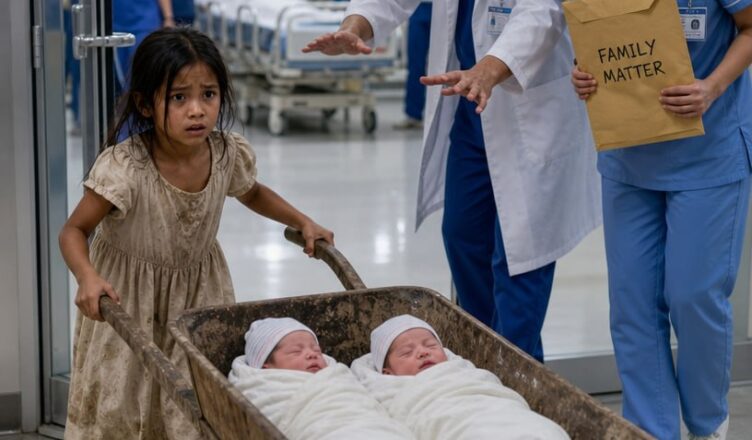
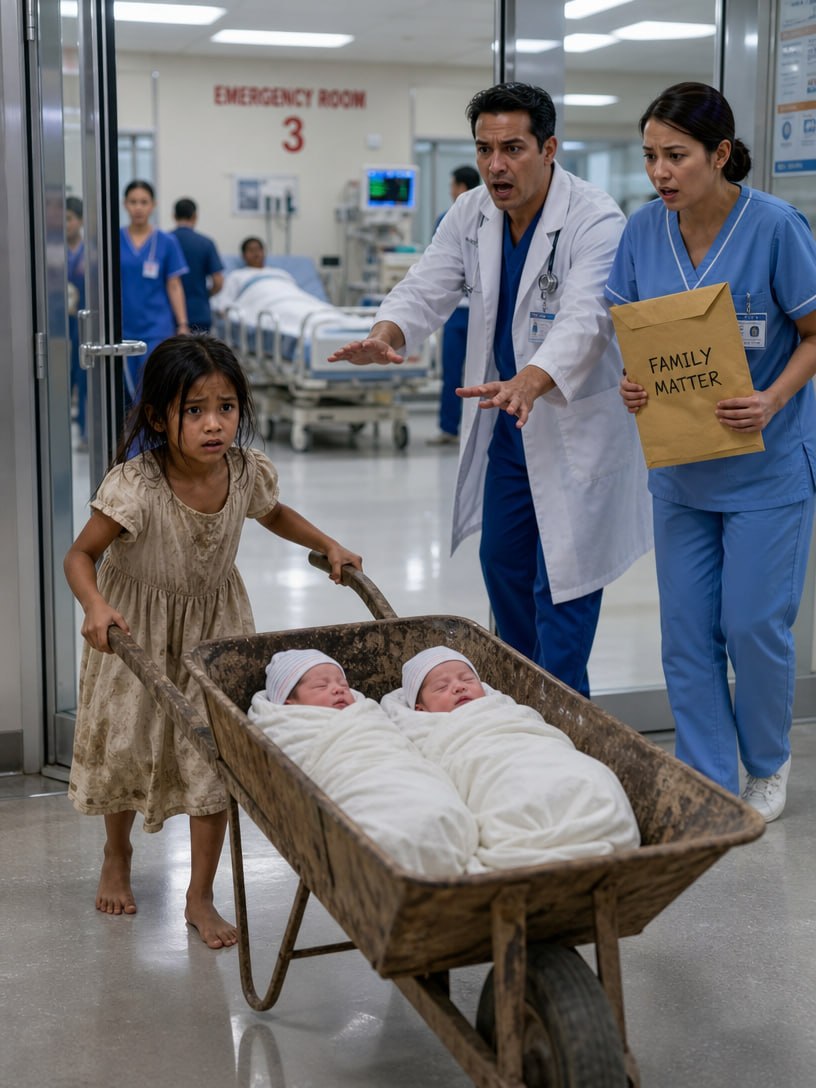
A little girl, about seven years old, was standing in the doorway.
She was barefoot. She wore a faded pink dress, and her hair was stuck to her forehead from the heat.
With both hands, she was pushing an old, rusty wheelbarrow.
Under a blanket were two newborn babies.
The little girl looked completely exhausted, but there was a determination in her eyes that seemed impossible for someone so young.
“Please help me,” she whispered. “I don’t know what else to do.”
Nurse Lupita was the first to approach her.
When she lifted the blanket, she froze.
There was a newborn boy and a newborn girl wrapped in old pieces of cloth. Both babies were extremely weak and needed immediate medical attention.
“Two newborns! Get everything ready!” I ordered.
Within seconds, our team went into action.
We prepared a mobile incubator and called the neonatal unit.
The babies were in critical condition, but they were still alive.
As we transferred them, the little girl tried to follow us.
But her legs finally gave out, and she collapsed to her knees.
Even then, she refused to let go of the wheelbarrow handles.
“Don’t take them away!” she cried desperately. “I promised I would bring them here!”
I knelt down in front of her.
“No one is going to take them away from you. We’re going to do everything we can to save them.”
The girl stared at me for several seconds, as if she were trying to decide whether she could still trust an adult.
“What’s your name?”
“Sofia.”
“Sofia what?”
“Sofia Morales.”
Her tiny hands were covered in cuts, and her feet were covered with painful scrapes.
I asked her where she lived.
She described a small house near the old El Sauz road, close to a damaged bridge.
“There’s a white house with a blue door and a huge cactus in front,” she explained.
I vaguely knew the area. The houses were scattered far apart, and some of the roads were difficult to travel.
“Is your mother there?”
Sofia nodded.
“She won’t wake up.”
“How long has she been like that?”
The little girl slowly counted on her fingers.
“Since Saturday.”
At that moment, I realized the situation could be far more serious than we had imagined.
“When were the babies born?”
Sofia lowered her eyes.
“That day. Mommy was screaming a lot. Then she told me to take care of Mateo and Lucía. After that, she fell asleep.”
Mateo and Lucía.
They already had names.
And they also had an older sister who, at only seven years old, was doing everything she could to keep them alive.
“Is there anyone else in the house?”
Sofia shook her head.
“My grandmother died. Mommy said there was no one left to help us.”
“And your father?”
The answer came immediately.
“I don’t have a father.”
She didn’t cry when she said it.
It was as if she had heard those words so many times that they had become the truth in her mind.
While the newborns were transferred to the specialized unit, we contacted the authorities and social services to determine what had happened and locate the mother.
But Sofia could think of only one thing.
Her brothers.
“Are they going to wake up?”
“We’re doing everything we can.”
“And Mommy?”
“We’re going to find her too.”
A short time later, we discovered something that shocked us even more.
Sofia had traveled an incredible distance to reach the hospital.
She had walked for hours, pushing that old wheelbarrow with the two newborns inside.
She had no water.
She had barely eaten.
At one point, a driver saw her and she begged him for help.
But the man didn’t take her seriously and simply drove away.
When we treated her injuries, Sofia barely complained.
“Is Mateo going to wake up?”
“We’re doing everything we can.”
“And Lucía?”
“She will too.”
The little girl lowered her head.
“Mommy always said older sisters have to take care of their family.”
I looked at her with a mixture of sadness and admiration.
“You did much more than that, Sofia.”
She didn’t smile.
“I wanted to go back to Mommy… but the babies stopped crying.”
A few hours later, my phone rang.
It was the leader of the team we had sent to the house.
“Dr. Rivera, we found the mother.”
I stood up immediately.
“Is she alive?”
There was a few seconds of silence.
“Yes. But she’s in very serious condition. The ambulance is already on its way.”
Sofia looked at me from her hospital bed.
“Is Mommy coming here?”
“Yes, Sofia. She’s on her way.”
For the first time since arriving at the hospital, the little girl began to cry.
But before the call ended, the man added:
“Doctor, there’s something else.”
“What?”
“We found an envelope beside the bed. It has your name written on it.”
I froze.
“My name?”
“Yes. It says: ‘Dr. Daniel Rivera, San Gabriel Civil Hospital.’”
A chill ran through me.
Then he added something even more disturbing.
“We also found an old photograph. You’re in it with a woman.”
When I received the photograph, my hands began to shake.
The woman in the picture was Mariana Morales.
The woman who had disappeared from my life eight years earlier.
And when I looked back at Sofia, I noticed something that sent a chill through me.
She had exactly the same eyes as Mariana.
PART 2
Mariana arrived at the hospital thirty-eight minutes later.
She was unconscious, extremely weak and severely dehydrated. She had suffered serious complications after giving birth at home without any medical assistance.
The moment I saw her, I recognized her face.
Mariana Morales.
The woman I had loved eight years earlier.
Back then, my mother, Beatriz, had given me a completely different explanation for Mariana’s disappearance.
She told me Mariana wanted a better life and had decided to leave of her own free will.
I believed her.
For eight years.
Until that envelope appeared.
My name was written in Mariana’s handwriting.
Inside was a single sentence:
“If I can’t tell him the truth, you must tell Daniel.”
I locked myself in my office and began reading.
Mariana explained that she had discovered she was pregnant eight years earlier.
She wanted to tell me.
But my mother had met her at a café in Guadalajara.
There, she showed Mariana fake messages that appeared to have been sent by me.
The messages claimed that I didn’t want children and that the pregnancy could destroy my career.
I had never written those messages.
At first, Mariana refused to believe them.
But my mother kept pressuring her.
She made Mariana believe she could get into serious trouble and even lose custody of her baby.
Mariana was only twenty-two years old.
Her father had died, her mother was ill, and she had practically no one to support her.
So she decided to leave.
Not because she had stopped loving me.
But because she believed she was protecting her daughter.
Inside the envelope were also copies of the forged messages and a letter I had written several months after Mariana disappeared.
In it, I asked her to contact me.
I told her that if she was pregnant, she should never have to face the situation alone.
Beside that letter, Mariana had written:
“Your mother made sure this letter never reached me.”
I sat there for a long time, unable to speak.
For eight years, I had lived believing a story that was never true.
The final page contained a message addressed to Sofia.
My hands began trembling again.
Through the glass, I could see the little girl sitting beside Lupita.
Every few minutes, she asked whether Mateo and Lucía were getting better.
My daughter.
That little girl who had walked for hours to save her brothers was my daughter.
But I needed to be certain.
I requested an official paternity test and asked social services to support Sofia throughout the entire process.
The result came shortly afterward.
99.99% probability of paternity.
Sofia was my daughter.
The next day, Mariana woke up.
Sofia entered the room first and gently hugged her mother.
Mariana lifted her eyes and saw me.
“Daniel…”
I stepped closer.
“I read your letter.”
She lowered her eyes.
“I thought you didn’t want us.”
I answered softly:
“And I thought you had abandoned us.”
Mariana closed her eyes.
“They stole eight years from us.”
Later, I knelt in front of Sofia.
“Sofia, there’s something very important I need to tell you.”
She looked at me carefully.
“Are you really my dad?”
My voice trembled.
“Yes. I’m your dad.”
Her eyes filled with tears.
But she didn’t cry.
She simply asked:
“Then… why did you never come looking for me?”
PART 3
Sofia’s question hung in the air.
She didn’t seem angry.
She was simply confused.
“You didn’t know I existed?” she asked.
I slowly shook my head.
“No. I didn’t know.”
Mariana was crying silently.
We explained to Sofia, using words she could understand, that some adults had hidden the truth and that she had never been given the chance to know her father.
She looked directly at me.
“If you had known I existed… would you have loved me?”
That question broke my heart.
“If I had known about you, I would have come looking for you. It wouldn’t have mattered where you were.”
Sofia looked down at her bandaged feet.
“I walked too.”
“I know.”
“My feet hurt.”
“I know, sweetheart.”
Then she threw her arms around me.
It was the first real hug between a father and his daughter.
I had missed so many important moments of her life.
Her first steps.
Her birthdays.
Her first words.
Her fears.
And yet, she hugged me as if she had been waiting for that moment her entire life.
The following days were filled with medical treatments, paperwork and small pieces of good news.
Mateo began eating better.
Lucía opened her eyes and gently squeezed Lupita’s finger.
Sofia, meanwhile, became known throughout the hospital.
Some people started calling her “the little girl with the wheelbarrow.”
But I refused to let anyone treat her like an attraction.
She was a child.
Not a spectacle.
Meanwhile, an investigation was opened into the information contained in Mariana’s letter.
And then came the moment I had feared most.
I had to confront my mother.
Beatriz entered my office as if nothing had happened.
I placed three documents on the table:
Mariana’s letter.
The forged messages.
And the DNA test results.
“Explain to me why a little girl grew up for seven years without her father.”
My mother remained silent.
Finally, she said:
“You were very young.”
“I was twenty-six.”
“You were just starting your career.”
“It was my life.”
She lowered her eyes.
“I thought Mariana wasn’t right for you.”
I showed her the messages.
“Did you forge them?”
She said nothing.
“Did you send them?”
Her eyes filled with tears.
“I thought I was protecting you.”
I shook my head.
“No. You wanted to make the decision for me.”
For the first time, my mother had no answer.
Then she asked if she could meet Sofia.
“She’s my granddaughter.”
I looked at her calmly.
“Yes. But she isn’t a reward for your guilt.”
I explained that any future meeting would depend on Sofia and would have to happen in an appropriate setting.
My mother left the hospital without meeting her.
When Mariana was finally discharged and the twins were out of danger, we didn’t pretend everything had suddenly returned to normal.
Eight years cannot disappear in a few days.
I rented a small house near the hospital for Mariana and the children.
I bought cribs, clothes, formula and a new pair of shoes for Sofia.
When she saw them, she asked:
“Are they mine?”
“Yes.”
“What if they get dirty?”
“We’ll wash them.”
“What if they break?”
“We’ll buy another pair.”
She wrapped her arms around my legs.
“I’ve never had shoes this comfortable.”
That sentence made me understand just how difficult her life had been.
Little by little, I learned how to be her father.
I took her to school.
Some mornings, I prepared her breakfast.
I discovered that she loved potato pancakes, hated certain vegetables and always carried a small stone in her pocket.
Mariana and I also began talking.
A lot.
Sometimes we cried.
Sometimes we laughed.
And sometimes we simply sat in silence.
One evening, Mariana said:
“I don’t know if we can ever get back what we had.”
I answered:
“I don’t want to force you into anything.”
She looked at me for several seconds.
“Then stay.”
“I’ll stay.”
“First as a father. As for everything else… let’s let time decide.”
And that was exactly what we did.
I stayed.
Not because of guilt.
Not because of obligation.
But because Sofia looked for me every time I entered a room.
Because Mateo calmed down whenever he heard my voice.
And because Lucía fell asleep while holding my finger.
Months later, the investigation into the lies and forged messages was still ongoing.
Some relatives thought I was taking things too far.
One aunt said to me one day:
“In the end, everything worked out.”
I looked at her.
“No. We simply managed to survive it. That’s not the same thing.”
Sofia also began receiving psychological support.
At first, she refused to talk about her journey.
But one day, she drew a large wheelbarrow with two babies inside and a little girl behind it.
The psychologist asked her:
“Why is the little girl so small?”
Sofia answered:
“Because nobody was helping her.”
That sentence stayed with me for a long time.
Sofia had been brave.
But no child should ever be forced to become a hero because the adults around them failed.
Almost a year later, the hospital held a small private ceremony.
There were no journalists.
No cameras.
Only some members of the medical staff, Mariana, the twins and Sofia.
The old wheelbarrow had been restored and placed in the hospital garden.
Beside it was a small plaque that read:
“In honor of Sofia Morales, the little girl who never stopped moving forward until she found help.”
Sofia slowly read the words.
Then she took my hand.
“Dad… was I really the one who did all of this?”
It was the first time she had called me that in front of everyone.
Dad.
I knelt in front of her.
“Yes, sweetheart. You were.”
She smiled.
“I was very scared.”
Mariana knelt beside her.
“But you kept moving forward.”
Sofia looked at the old wheelbarrow and then at her little brothers, who were sleeping peacefully.
“I thought I came here to save them.”
Then she looked at me.
“But I also found my dad.”
I wrapped my arms around her.
Sometimes life cannot give us back the years we have lost.
It cannot bring back forgotten birthdays, first words, nights when a child needed their parents, or all those moments that will never return.
But the truth always finds a way to come to light.
Sometimes it arrives in a letter.
Sometimes it appears in an old photograph.
And sometimes it arrives barefoot, pushing an old wheelbarrow with two newborn babies inside.
Sofia had entered the hospital looking for help for her family.
Without knowing it, she had also uncovered a truth that would change several lives forever.
And above all, she had given a family separated for eight years a chance to begin again.
Because some truths can remain hidden for a very long time… but sooner or later, they always find their way into the light.
