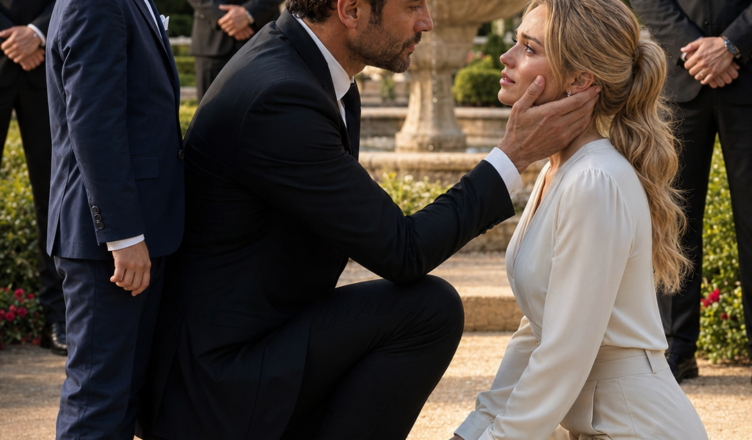
“Miss, if you’ve taken this child by the hand, I can only hope his father believes you were trying to help him.”
That was what a balloon seller told me the moment he saw me holding the hand of a little boy who was crying in the middle of Chapultepec Forest.
At first, I didn’t understand why he sounded so serious.
The boy looked about five years old.
He was wearing an elegant navy-blue suit, a spotless white shirt, and perfectly clean shoes. He didn’t look like a child who had simply wandered away while playing near the park stalls.
And yet, there he was.
Alone.
Terrified.
“Mommy… Mommy…”
People looked at him and continued walking. Some probably thought he was simply throwing a tantrum. Others took out their phones to watch what was happening.
I crouched down in front of him.
“Are you lost, sweetheart?”
He kept crying.
I tried speaking to him in English.
No reaction.
Then I slowly tried Spanish.
Still nothing.
A few seconds later, I heard a different word.
“Papa…”
Italian.
I didn’t speak Italian perfectly, but I had worked for two years at an Italian restaurant in Roma Norte. The owner, Doña Alessandra, had taught me a few phrases while we prepared coffee.
I never imagined those few words would one day help me comfort a lost child.
I took a breath.
“Don’t be afraid. I’m here to help you. What’s your name?”
The boy looked at me as though someone had finally understood his fear.
“Matteo,” he answered between sobs.
He explained that he had been walking with his father when he saw a small dog and followed it for a few moments. When he turned around, his father was gone.
His fingers were trembling.
I held out my hand.
He squeezed it so tightly that my heart ached.
“We’re going to find your father.”
I didn’t get three steps.
Three men dressed in black appeared between the trees.
They didn’t look like ordinary people who were simply worried. They moved with precision, carefully watching everything around them.
One spoke briefly into his phone.
Another scanned the area.
The third approached us.
Matteo suddenly looked up.
“Marco!”
The man hurried toward us and checked that the boy was unharmed.
Then he looked at me.
“Who are you?”
“Someone who found a child crying.”
His expression remained serious.
Then a deep voice sounded behind us.
“What’s going on?”
A tall man in a dark suit approached.
He didn’t need to raise his voice to command the attention of everyone around him.
Matteo let go of my hand and ran toward him.
“Papa!”
The man’s expression changed instantly.
He took his son into his arms, carefully checked him, and spoke softly to him in Italian.
For a few seconds, he no longer looked like a distant, intimidating man.
He simply looked like a father who had just found his child.
Then he turned toward me.
“You stayed with him?”
“I only tried to help him until you arrived.”
“You speak Italian?”
“A little.”
He studied me for several seconds.
“Enough for my son to trust you.”
Then he introduced himself.
“Santiago Vitale.”
The name sounded familiar.
In Mexico City, the Vitale name circulated in certain business circles and in conversations whose real meaning I had never understood.
“Lucía Herrera,” I replied.
Matteo, still in his father’s arms, looked at me and smiled.
“The nice lady.”
I smiled back.
But when I turned around, the balloon seller was gone.
He had left without saying a word.
As if he had seen something he would rather forget.
Santiago thanked me.
I explained that I worked at a small café in Condesa and needed to return to work.
He didn’t argue.
“Marco will escort you.”
“That’s not necessary.”
“For me, it is.”
I didn’t insist.
That evening, while serving coffee and trying to return to my normal life, I couldn’t stop thinking about Matteo.
His tiny hand squeezing mine.
His frightened eyes.
And, above all, the look in Santiago Vitale’s eyes.
At seven that evening, the café doorbell rang.
The entire café fell silent.
Santiago walked in with Matteo.
The boy was holding a colorful drawing against his chest.
“For you,” he said in Italian.
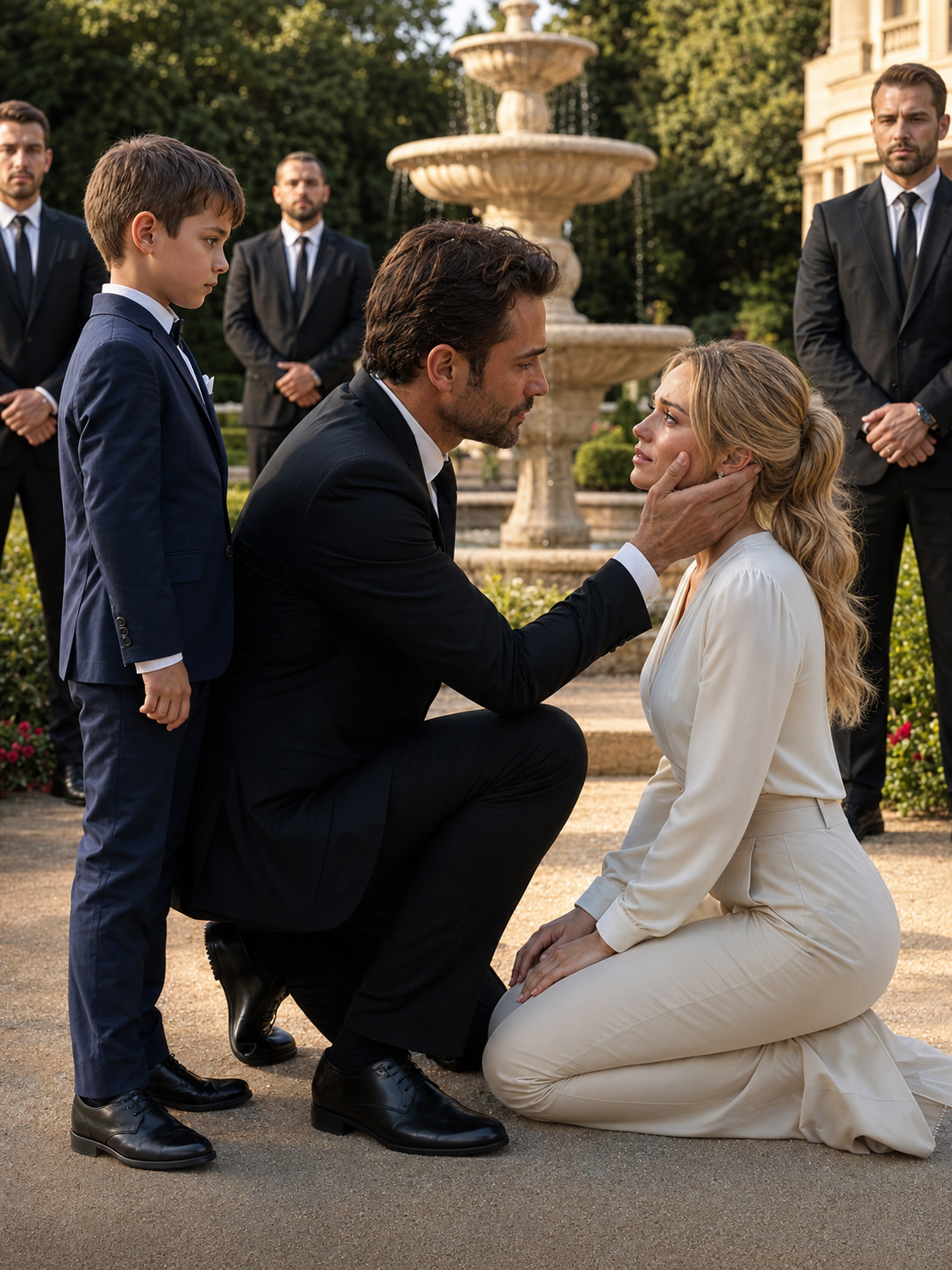
I took the paper.
It showed a little boy beneath a tree, a woman holding his hand, and above them, a few words written in childish handwriting:
The nice lady.
I struggled to hold back my emotion.
Santiago placed a small ivory-colored card on the counter.
“If you ever need anything, call me.”
“I don’t think I’ll need it.”
He held my gaze.
“The most important things often begin that way.”
When they left, my coworker Paulina picked up the card.
Her expression changed.
“Lucía… do you know who that man is?”
I didn’t answer.
Because on the back of the card, a handwritten sentence left me frozen.
Your mother would have done the same.
PART 2 — The Woman Who Recognized the Locket
For three days, I didn’t call Santiago Vitale.
The little card remained hidden inside a drawer in my kitchen.
But every time I saw it, I remembered those words.
Your mother would have done the same.
My mother’s name was Elena.
She died when I was thirteen.
I had only a few things left that belonged to her: some photographs, an old lemon cake recipe, and a small oval silver locket.
I always wore it around my neck.
I had never been able to open it.
One Friday afternoon, while rain pounded against the large windows of the café, an elderly woman walked in.
She wore an elegant beige coat and a silk scarf.
She didn’t look like an ordinary customer.
She looked as though she had come to confirm something.
She ordered tea.
When I brought it to her, she looked at me over her glasses.
“You’re Lucía Herrera.”
It wasn’t a question.
“Yes.”
She gave me a faint smile.
“I’m Isabella Vitale. Matteo’s great-grandmother.”
She asked me to sit down.
I looked at Paulina behind the counter. She discreetly motioned for me to accept.
Isabella spoke calmly.
She told me Matteo still talked about me and the woman who had helped him in the park.
Then her eyes dropped to my neck.
To the locket.
Her hand trembled slightly.
“It’s beautiful.”
“It belonged to my mother.”
“What was her name?”
A hint of suspicion settled over me.
“Elena.”
Isabella fell silent.
“Elena Herrera?”
“Yes.”
She slowly placed her cup on the table.
“I believe I’ve seen this design before.”
At that moment, the door opened.
Santiago walked in.
When he saw us together, his expression changed.
“Nonna,” he said softly.
Isabella stood.
As she passed him, she whispered something in Italian.
I understood every word.
“She has Elena’s eyes.”
Santiago clenched his jaw.
That night, I went through my mother’s belongings.
I found an old postcard from Florence.
On the back, in her handwriting, she had written:
Forgive me for leaving Italy.
I stared at the sentence for a long time.
I had never known my mother had lived in Italy.
The next day, I went to my aunt Carmen’s house. She was the only one of my mother’s sisters still alive.
The moment she saw the postcard, her expression hardened.
“Mom lived in Italy?”
“Yes.”
“How long?”
“Almost two years.”
“Why did you never tell me?”
My aunt lowered her eyes.
“Because I wanted your life to begin in Mexico, far away from that family.”
A chill ran through me.
“The Vitales?”
She didn’t answer.
She didn’t need to.
I showed her the locket.
She immediately covered her mouth.
“Elena made me promise something.”
“What?”
“If someone ever recognized this locket, I had to protect you and keep you away from that family.”
“Why?”
My aunt closed her eyes.
“Because there were things your mother never wanted you to discover.”
My phone vibrated inside my bag.
It was Santiago.
I answered.
“Lucía, don’t go home.”
I straightened.
“Why?”
“I had the cameras around your building checked. Someone has been asking questions about you.”
“Who?”
There was a silence.
“A woman.”
“What woman?”
Santiago took a breath.
“A woman who was wearing a locket similar to yours.”
PART 3 — The Hidden Truth
I didn’t listen to him.
I went home anyway.
My apartment was on the third floor of an ordinary building in the Doctores neighborhood.
The door was closed.
But the lock had obvious marks.
Someone had broken in.
Before I could touch the handle, I heard footsteps on the stairs.
Santiago arrived with two men.
He didn’t look worried.
He looked determined.
“I told you not to come.”
“It’s my home.”
“And someone entered it using a key.”
Those words took my breath away.
Almost nothing inside the apartment had been disturbed.
My computer was still there.
The money was untouched.
Even my jewelry remained in its box.
Only one thing was missing.
The box containing my mother’s belongings.
Her photographs.
Her letters.
The postcard from Florence.
Everything was gone.
Soon afterward, the authorities arrived to examine the apartment.
My aunt Carmen came as well.
When she saw Santiago, she fell silent.
Then Isabella appeared in the hallway.
She was leaning on a cane.
“It’s time,” she said.
I stood.
“I’m tired of everyone talking about my life as if it were some secret file.”
Isabella looked at me sadly.
“Your mother was Elena Herrera in Mexico. But in Italy, she used another name.”
“Why?”
“To protect herself.”
Then she began telling me a story no one had ever revealed to me.
Thirty years earlier, Elena had worked as a translator for the Vitale family in Florence.
She was young, intelligent, and brave.
She had become close to Luciana, Isabella’s daughter.
Luciana had discovered documents concerning old financial arrangements and dealings that certain powerful people wanted to keep hidden.
Elena decided to help her preserve that information.
But someone discovered what they were doing.
Luciana died in what was officially described as an accident.
Isabella, however, had always believed the story was much more complicated.
Then she looked at my locket.
“It belonged to Luciana.”
I instinctively touched the pendant.
“She gave it to Elena before she disappeared.”
Santiago explained how to open it.
He asked for permission to examine it.
I nodded.
He carefully pressed a small section along the inner edge.
Click.
The locket opened.
Inside was a tiny folded piece of paper.
An address was written on it.
We went to the location in Mexico City’s historic center.
The address belonged to an old notary’s office.
An elderly man who had once worked there recognized Luciana’s name.
A few minutes later, he returned carrying a small metal box.
Inside were documents, photographs, and an old audio cassette.
In one of the photographs, I recognized my mother.
She was much younger.
Beside her stood an Italian woman with light-colored eyes.
Luciana.
They were smiling in front of the Duomo in Florence.
On the back of the photograph, Elena had written:
If anything happens to us, Lucía must know that she was loved before she was even born.
I stood frozen.
“Lucía?”
My aunt Carmen began to cry.
Isabella took a deep breath.
“Your mother left Italy while she was pregnant.”
I felt the ground disappear beneath my feet.
“Pregnant with whose child?”
Isabella looked at the old cassette.
We decided to listen.
Elena’s voice filled the room.
“My name is Elena Herrera. If this recording has been found, it means Luciana never had the chance to tell her own story.”
Her voice trembled.
“I promised to protect her daughter.”
I looked at Isabella.
“Her daughter?”
She slowly nodded.
Elena’s voice continued:
“If Lucía is still alive, I want her to know one thing: I protected her because I wanted her to grow up freely, far away from the conflicts surrounding this family.”
Then another voice appeared on the recording.
It was Luciana’s.
She spoke in Italian.
She explained that she was afraid for her daughter and that Elena had agreed to help her.
If anything happened to Luciana, Elena was supposed to leave with the baby and give her a new life.
I felt as though I were listening to someone else’s story.
Then I understood.
The woman I had called Mom throughout my childhood had raised me with all her love.
But she wasn’t my biological mother.
My biological mother was Luciana.
Elena had been the woman who protected me.
Two women.
Two stories.
One love.
I couldn’t speak.
But one question remained.
“Who was the woman who broke into my apartment?”
Santiago took out his phone.
A few minutes later, he received a new video from the security cameras.
The woman was leaving my apartment.
This time, her face was clearly visible.
Isabella covered her mouth.
“Claudia.”
Santiago froze.
“Who is Claudia?”
He took several seconds before answering.
“My mother.”
Silence filled the room.
Claudia had spent months searching for information about Luciana’s past.
She had discovered that documents still existed that could expose long-hidden family secrets.
She had tried to recover those documents before they could become public.
Eventually, my mother’s box was found.
The documents were handed over to the appropriate authorities.
The case was officially investigated, and several aspects of the Vitale family’s past were reopened.
Isabella agreed to testify.
Santiago also decided to hand over the documents he had in his possession.
For him, the truth now mattered more than the family name.
EPILOGUE — Two Mothers, One Story
A few months later, I visited Elena’s grave.
I placed flowers there.
Then I took out a letter that had been found inside the recovered box.
I read it slowly.
“Forgive me, Lucía. I couldn’t give you the whole truth, but I could give you a life.”
I cried for a long time.
I wasn’t angry with her anymore.
At last, I understood why she had remained silent.
She hadn’t hidden the truth to hurt me.
She had hidden it to protect me.
A few days later, I visited Luciana’s grave for the first time.
I placed a few flowers there.
Then I held the locket in my hands.
I opened it.
For several seconds, I simply stared at it.
I don’t know if blood alone is enough to define a family.
I only know that love can cross years, borders, and even secrets.
One woman gave me life.
Another gave me a childhood.
And a little boy lost in Chapultepec had unknowingly opened the door to a truth everyone believed had been forgotten.
For a long time, I thought a family began with a last name.
Today, I think differently.
Sometimes, a family begins with nothing more than an outstretched hand.
A small hand that squeezes yours.
And a trembling voice that, without even knowing it, finally guides you home.
