When my mother told me that my twelve-year-old daughter had to stay locked upstairs so my parents could host forty guests at my farmhouse, I didn’t argue.
I simply said:
“Okay.”
Mom apparently heard obedience in my voice.
She didn’t realize I had finally stopped asking for permission.
My daughter, Lily, had returned home only eleven days earlier after a bone-marrow transplant. Her doctors had been extremely clear: for the time being, exposure to crowds and infections had to be avoided as much as possible.
My parents knew that.
They also knew they had planned their anniversary celebration at my farmhouse.
Still, my mother looked at me and said:
“Then keep her upstairs. The guests don’t need to see her.”
I stared at her for a moment.
“All right.”
That was all I said.
By Friday evening, I had removed everything my parents had brought onto the property.
The folding tables from the barn.
The decorations.
The cases of drinks.
The extra furniture and personal belongings they had stored in the guest rooms.
Everything was carefully packed and placed in a rented storage unit registered under my father’s name.
Then I changed the security code on the main gate.
I replaced the exterior locks.
Finally, I placed a clearly visible notice at the entrance stating that unauthorized visitors could not enter the property.
My parents had spent years treating the farmhouse as though it belonged to them.
It didn’t.
It belonged to me.
Seven years earlier, I had purchased the property from my grandmother for its appraised value.
My parents hadn’t wanted it.
They thought the house needed too many repairs and that the surrounding land was more trouble than it was worth.
After I renovated it, their attitude changed.
Suddenly, it wasn’t “Emily’s farmhouse.”
It became “the family farmhouse.”
I had tolerated that for years.
But I wasn’t going to risk Lily’s health for their party.
Saturday morning arrived.
Just after nine, I heard vehicles approaching along the gravel road.
First came my parents’ silver Cadillac.
Behind it were several buses carrying their guests.
A catering truck followed.
Then came a florist and a small group of musicians.
My parents had apparently arrived expecting a celebration.
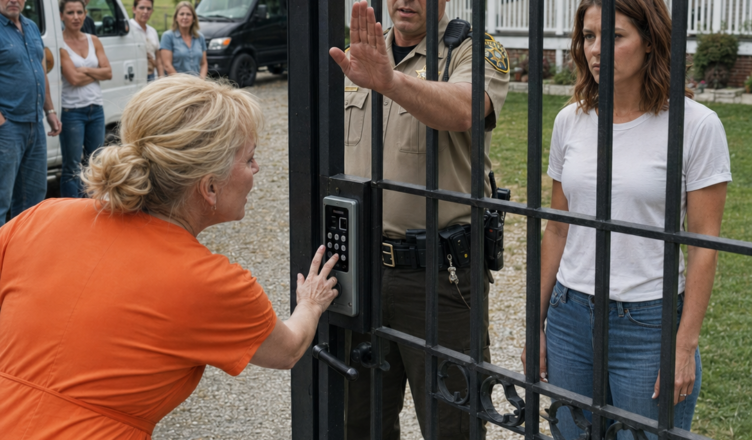
Instead, they found Sheriff Daniel Brooks standing beside the locked gate.
I watched from the living-room window.
Behind me, Lily was resting in the sanitized room we had prepared for her.
She was still weak.
She was still wearing a protective mask.
And she needed peace, not dozens of strangers wandering through the house.
My mother stepped out of the Cadillac.
The moment she saw the locked gate, her expression hardened.
“Why is this locked?”
Sheriff Brooks calmly showed her the notice.
“Mrs. Carter, the property owner has withdrawn permission for today’s event.”
My mother stared at him.
“I am her mother.”
The sheriff didn’t raise his voice.
“That doesn’t make you the property owner.”
My father stepped forward.
“She agreed to prepare the house for us.”
I opened the front door.
“I agreed to clear the house.”
My mother looked at me.
I continued:
“And I did.”
Her eyes narrowed.
“What exactly does that mean?”
“It means everything you brought here has been removed.”
The guests were beginning to gather behind her.
Some looked confused.
Others were already whispering.
My mother stepped closer to the gate.
“You cannot do this to us.”
“I can.”
“This is a family event.”
“Then you should have remembered that Lily is family too.”
My mother looked toward the upstairs windows.
Then she saw my daughter standing behind the glass.
Lily was pale, but she was watching everything.
Mom pointed toward her.
“She can stay upstairs. That’s what we agreed.”
The sheriff looked at me.
I said nothing.
Then Mom continued shouting.
“She doesn’t have to come downstairs. Nobody is asking her to participate.”
I took a breath.
“She shouldn’t have to be isolated in her own home because you want to entertain forty people.”
My mother’s expression became cold.
“You’re making a scene.”
“No. I’m protecting my daughter.”
She grabbed the gate and looked toward the keypad.
“Open it.”
“No.”
She tried the old access code.
Nothing happened.
She tried again.
Still nothing.
Her face reddened.
“You changed the code?”
“Yes.”
“You had no right.”
I looked at her through the bars.
“It is my house.”
For a moment, nobody spoke.
Then my mother began accusing me of humiliating the family.
Sheriff Brooks calmly asked her to step away from the gate.
Instead, she reached through the bars toward the keypad.
“Mom,” I said firmly.
She stopped.
Then I took out my phone.
“There is something else you should hear.”
My mother stared at me.
I opened an old voicemail.
Her own voice came through the speaker.
“If Emily refuses, we’ll use the kitchen entrance. She won’t dare make a scene with everyone watching.”
The guests fell silent.
My father’s expression changed.
Sheriff Brooks listened carefully.
When the recording ended, he looked directly at my mother.
“Did you make that statement?”
She didn’t answer.
My father stepped toward her.
“Did you?”
Still nothing.
I looked upstairs.
Lily was still standing behind the window.
She had heard enough.
I turned back toward my parents.
“For years, I let you decide what happened in this house because I thought keeping the peace was the same thing as keeping the family together.”
I shook my head.
“I was wrong.”
Sheriff Brooks folded the notice and returned it to his folder.
“Mrs. Carter, Mr. Carter, you and your guests need to leave the property.”
My mother stared at me.
“You’re choosing your daughter over your own parents?”
I answered quietly.
“I’m choosing my daughter over a party.”
She had no response.
The buses slowly turned around.
The catering truck followed.
The musicians packed away their equipment.
And the anniversary celebration that had been planned for weeks ended before anyone crossed the gate.
I watched the vehicles disappear down the road.
Then I went back inside.
Lily was sitting on the edge of her bed.
“Are they gone?”
“Yes.”
She looked relieved.
“Am I in trouble?”
I sat beside her.
“No, sweetheart.”
I gently took her hand.
“You did nothing wrong.”
She leaned against me.
For the first time that morning, I could breathe.
The farmhouse became quiet again.
No crowds.
No music.
No strangers.
Just the sound of my daughter breathing peacefully in the room beside me.
And I realized something I should have understood years earlier:
Sometimes setting a boundary doesn’t mean destroying a family.
Sometimes it means finally protecting the person who depends on you most.
