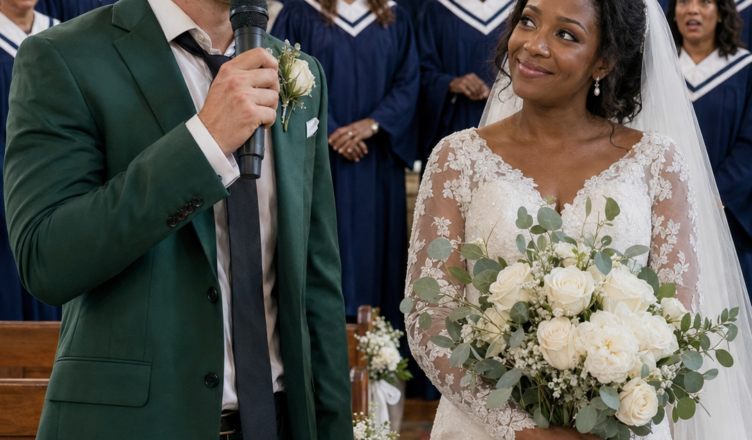
On a bright Saturday morning in Birmingham, England, a small church slowly filled with wedding guests.
People smiled, greeted one another, and found their seats. But beneath the polite conversations was a subject everyone seemed eager to discuss.
The bride.
Grace Johnson, a 32-year-old nanny, had spent years working in other people’s homes, caring for children and quietly putting her own needs aside. She was known for her patience, generosity, and gentle nature.
That morning, she wasn’t wearing an elaborate bridal gown.
Her dress was simple, modest, and far less expensive than anything most of the guests had expected to see at a wedding.
And then there was the groom.
Daniel Brooks stood beside her in an old suit that had clearly seen better days. His shoes were worn, his jacket was slightly loose, and his beard had grown out.
Several guests had already decided what his appearance meant.
Some assumed he had been living on the streets.
Others whispered that Grace had made a terrible mistake.
A few people didn’t even bother lowering their voices.
Three of Grace’s longtime acquaintances sat together near the front.
“Are you really surprised?” one whispered. “She could have chosen someone completely different.”
Another glanced toward Daniel and shook her head.
“I still don’t understand what she sees in him.”
The third woman smiled sarcastically.
“Maybe we’ll find out before the ceremony is over.”
Grace heard them.
She also heard the quiet laughter from behind her.
For a moment, embarrassment threatened to overwhelm her.
Then Daniel reached for her hand.
His fingers were rough from years of difficult work, but his grip was gentle.
Grace looked at him and smiled.
That was all she needed.
The ceremony continued.
The pastor spoke about commitment, loyalty, and the importance of seeing a person’s character rather than their possessions.
When it was time for the vows, Grace’s voice trembled slightly.
“I choose you,” she said. “Not because of what you own, or what anyone else thinks of you. I choose you because of the person I’ve come to know.”
The church became unusually quiet.
Then Daniel began his vows.
His voice was soft at first.
“I promise to stand beside you when life is easy, and especially when it isn’t.”
A few people exchanged amused looks.
Someone near the back quietly laughed.
One of Grace’s former friends whispered something that made the women beside her chuckle.
Daniel paused.
Instead of reacting angrily, he simply looked at Grace.
Then he turned toward the pastor.
“May I say something before we finish?”
The pastor nodded.
Daniel walked toward the microphone.
His worn shoes made a faint sound against the wooden floor.
The room gradually fell silent.
Everyone expected an emotional declaration about love.
Instead, Daniel looked across the church and said:
“I know what many of you think when you look at me.”
No one moved.
“You see an old suit. You see worn shoes. You see a man who doesn’t look successful.”
He paused.
“And you’ve decided you know my story.”
Grace watched him quietly.
Daniel continued.
“For the past year, I’ve watched Grace give everything she has to people who barely noticed how much she sacrificed. She cared for their children, stayed late when they needed her, and showed up even when she was exhausted.”
His voice became steadier.
“But none of you asked who was caring for Grace.”
The laughter had disappeared completely.
Daniel reached into the inside pocket of his jacket and removed a small envelope.
“I didn’t come into Grace’s life with money. I didn’t have a beautiful home to offer her. At one point, I didn’t even have a place of my own.”
He looked down briefly.
“That part is true.”
Several guests shifted uncomfortably.
“But what you don’t know is why.”
Daniel explained that years earlier, he had owned a successful construction business. After a serious series of financial setbacks, he had lost almost everything. Rather than asking relatives or friends for money, he had spent years rebuilding his life from the ground up.
During that time, he had worked temporary jobs, slept wherever he could afford to stay, and saved every bit of money he could.
He had never told Grace the full extent of his past because he didn’t want her to love him for what he once had.
Then he opened the envelope.
Inside was a letter confirming that he had recently completed the purchase of a modest home.
Not a mansion.
Not a luxury property.
Just a warm, safe place where he and Grace could begin their married life together.
But Daniel wasn’t finished.
He turned toward the guests.
“The house isn’t the important part.”
He looked at Grace.
“She is.”
Grace covered her mouth as tears filled her eyes.
Daniel smiled.
“I didn’t marry her because she needed someone to rescue her. I married her because she was the only person who treated me like a human being when she had no reason to expect anything from me.”
Nobody laughed anymore.
The women who had mocked Grace earlier sat completely still.
Daniel placed the envelope in Grace’s hands.
“And for everyone who thought this wedding was a joke,” he said gently, “I hope you remember something.”
He looked around the church.
“Sometimes the poorest-looking person in the room has the richest heart. And sometimes the person everyone underestimates is the one who has been quietly rebuilding his entire life.”
Grace stepped toward him.
She took his hand again.
This time, the church erupted—not in laughter, but in applause.
The pastor smiled and invited them to return to the altar.
As Grace and Daniel stood together, she no longer noticed the simple dress, the old suit, or the whispers.
She only saw the man who had chosen her when neither of them had anything to prove.
And that was more valuable than any expensive wedding could have been.
