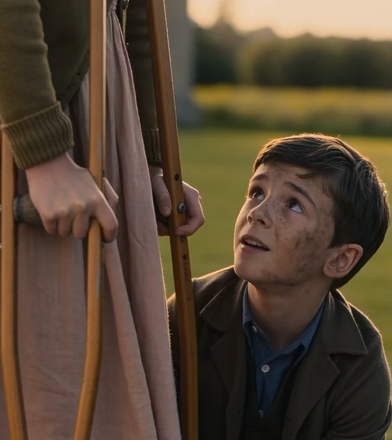
At eleven years old, Clara Bellamy knew every room of Bellamy House but almost nothing about the world beyond its gates.
The old country estate was beautiful enough to appear in a painting. Ivy climbed the pale stone walls, roses bordered the terraces, and beyond the western lawn stood an iron gate opening toward the village.
Clara rarely reached even halfway to it.
Two wooden crutches accompanied her everywhere.
Years earlier, after a serious childhood injury, she had gone through a long recovery. Although her strength had gradually returned, her father, Jonathan, remained deeply cautious. He arranged lessons at home, discouraged strenuous activity, and insisted that Clara never move around the grounds without support.
The household interpreted his rules as devotion.
Clara experienced them differently.
She felt as though her entire life had been organized around what might go wrong.
Then she met Samuel.
He was twelve, the son of a woman who worked at the estate. He was usually easy to identify from a distance: untidy brown hair, worn boots, and hands that somehow collected dirt no matter what task he had been given.
Their first real conversation happened near the greenhouse.
Samuel had noticed Clara watching him climb an apple tree.
When he jumped down, he found her staring.
“Would you like one?” he asked, holding out an apple.
“I’m not allowed over there.”
Samuel glanced at the grass separating them.
“The tree isn’t over there anymore. The apple is here.”
Clara tried not to smile.
She failed.
That apple began a friendship neither family had planned.
During the weeks that followed, Samuel started finding excuses to work near the western garden. Clara began finding excuses to read there.
He told her about the village school, the creek beyond the hill, and the abandoned windmill that children claimed was haunted.
She told him about the countries in her books and the places she intended to visit someday.
One afternoon Samuel looked at her crutches.
“Do your legs hurt?”
“Not usually.”
“Can you stand without those?”
Clara stiffened.
“For a moment.”
“Have you ever tried longer?”
“My father says I shouldn’t.”
Samuel considered this.
“That still doesn’t answer the question.”
Clara disliked him for approximately five seconds.
Then she admitted the truth.
She didn’t know.
Fear had become such a normal part of her routine that she could no longer tell where physical limitation ended and expectation began.
Samuel never suggested anything reckless. Instead, he encouraged her to ask questions and to tell her father she wanted another professional evaluation of her mobility.
But Clara was afraid even to do that.
So Samuel started with something much smaller.
He challenged her to stand while holding a garden bench instead of putting all her weight on the crutches.
The first attempt lasted only a few seconds.
The second lasted longer.
Clara’s legs trembled, and Samuel immediately told her to sit.
But something had changed.
She had expected helplessness.
Instead, she had discovered uncertainty.
And uncertainty, unlike certainty, left room for possibility.
One warm evening, Samuel found an old metal basin near a gardening shed. Clara had been complaining that one foot felt sore after spending the afternoon practicing with her supports, so they sat beside the gravel path and rested.
Samuel filled the basin with water.
Clara dipped her foot into it while he knelt nearby, washing soil from his own hands.
Golden sunlight stretched across the garden.
“Do you think I’ll ever walk normally?” she asked.
Samuel thought carefully before answering.
“I don’t know.”
Clara looked disappointed.
“You were supposed to say yes.”
“I’d rather tell you the truth.”
He nodded toward the house.
“But I think you deserve to find out what you can do instead of spending your whole life assuming you can’t.”
Clara stared at the water.
Samuel rose and offered his hand without pulling her.
“Want to try standing?”
She gripped one crutch.
Her breathing quickened.
“What if I can’t?”
“Then you sit down.”
“And if I fall?”
“Then we learn that wasn’t the right way to do it.”
Clara hesitated.
Samuel smiled.
“One small try.”
She placed her foot carefully on the gravel.
Then the other.
For a moment, both crutches remained beneath her arms.
Slowly, she reduced the pressure on them.
Her knees shook.
Samuel remained close but didn’t touch her.
Clara was standing.
Not confidently.
Not for long.
But standing.
Her eyes widened.
“Samuel…”
Then they heard footsteps.
Jonathan Bellamy was crossing the garden.
His expression tightened the instant he understood what was happening.
“Clara.”
Her shoulders dropped.
Samuel stepped away.
Jonathan approached and looked from the basin to the crutches and finally to his daughter.
“That’s enough for today. Come inside.”
Clara lowered her gaze.
For years, those words would have ended the discussion.
This time they didn’t.
“Father, wait.”
Jonathan stopped.
“I want to know if I can get stronger.”
His face changed.
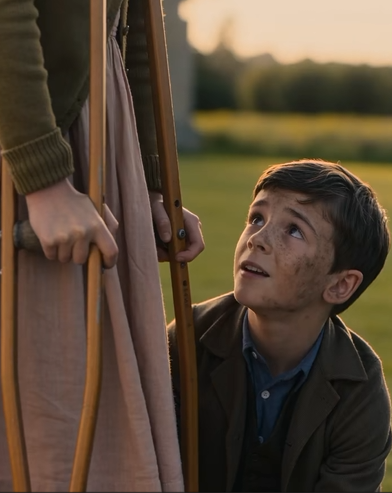
Clara had expected anger.
Instead, she saw something she had never recognized before.
Fear.
Not hers.
His.
“Please,” she said. “I want to try properly.”
Jonathan said nothing for several seconds.
Then he quietly led her toward the house.
The following morning Samuel was told he should keep his distance from Clara.
Soon afterward, his mother accepted work elsewhere, and the family moved away.
To Clara, the timing seemed obvious.
She assumed her father had arranged it.
For the first time in her life, disappointment hardened into resentment.
But Jonathan could not erase what had happened in the garden.
Neither could Clara.
She began asking questions.
Eventually, Jonathan agreed to take her for a new assessment.
The conclusion was more hopeful than Clara had expected. Her recovery would require patience, supervision, and structured rehabilitation, but improvement was possible.
Clara worked steadily.
There were difficult weeks when progress seemed invisible.
There were days when she wanted her crutches back simply because they were familiar.
But gradually, her world expanded.
First came several supported steps.
Then a short distance across a room.
Later, she crossed the terrace.
One spring morning, nearly seven years after meeting Samuel, Clara came downstairs using only the handrail.
Jonathan was standing in the entrance hall.
When he saw her, he didn’t speak.
Clara reached the final step.
“I told you I wanted to find out.”
Jonathan sat down.
His eyes filled with tears.
“I know.”
That evening, he finally explained what Clara had never fully understood.
Her childhood accident had changed him too.
After nearly losing his daughter, Jonathan had begun treating every uncertainty as a threat.
Doctors had encouraged gradual rehabilitation, but he had focused on every warning and overlooked every possibility.
He had convinced himself that caution could guarantee safety.
Instead, his fear had quietly become Clara’s.
“I thought keeping you from falling was the same as protecting you,” he admitted.
Clara sat across from him.
“And Samuel?”
Jonathan looked away.
That question seemed harder.
“I told him to stay away.”
“So you did send them away.”
“No.”
Clara frowned.
Jonathan explained that Samuel’s mother had already accepted another position before the garden incident. He had, however, been relieved when they left, and he had never corrected Clara’s assumption.
That distinction did not excuse him.
Jonathan knew it.
“I’m sorry,” he said. “Not because you became angry with me. Because I gave my fear authority over your life.”
Clara wasn’t ready to forgive him completely.
But for the first time, she understood him.
And understanding created a small opening where resentment had once been solid.
Years passed.
Clara eventually left the estate and studied rehabilitation therapy.
Her childhood gave her an unusual sensitivity toward frightened patients. She understood that recovery wasn’t simply a question of muscles and joints. Sometimes a person also had to rebuild trust in their own body.
She became especially devoted to children.
Whenever a frightened child asked, “What if I can’t?” Clara never promised success.
She would say, “Then we’ll discover what you can do, one step at a time.”
Decades later, Bellamy House came back into her life.
After Jonathan’s death, Clara inherited the estate.
By then, maintaining such a large private residence made little sense.
People expected her to sell it.
Instead, she transformed it.
Bedrooms became family accommodation.
Several sitting rooms became consultation spaces.
The old ballroom became a bright rehabilitation hall.
And the western garden was redesigned with accessible paths where children could practice moving outdoors.
Clara kept one part almost unchanged.
The fountain.
She couldn’t explain why.
Perhaps because it marked the invisible border of her childhood—the place beyond which she once believed she wasn’t supposed to go.
The rehabilitation center had been open for several months when a parcel arrived.
There was no elaborate message.
Inside was a small wooden apple.
On the bottom, someone had carved:
FOR THE GIRL WHO FINALLY MADE IT PAST THE FOUNTAIN.
Clara sat motionless at her desk.
There was only one person who could have written that.
Samuel.
A short note gave the name of a woodworking shop in a nearby town.
Clara went the following afternoon.
A bell sounded when she opened the door.
The shop smelled of cedar and fresh sawdust. Shelves displayed hand-carved toys, furniture, walking sticks, and carefully crafted mobility aids.
An older man was sanding a wooden handle at the rear of the room.
He looked up.
Neither of them spoke immediately.
Time had changed almost everything about him.
Almost.
His hands were still covered in dust.
Clara smiled.
“Still impossible for you to stay clean?”
The man stared at her.
Then recognition spread across his face.
“Clara?”
She nodded.
Samuel laughed softly.
“Look at you.”
“That’s all you’re going to say after nearly forty years?”
“I had a better speech prepared.”
“What happened to it?”
“You walked in.”
They talked until the afternoon light disappeared from the windows.
Clara learned that Samuel had become a craftsman. Over the years, he had started designing customized wooden supports and adaptive furniture after helping a relative during rehabilitation.
Then he surprised her.
He had known about Bellamy House.
In fact, he had quietly contributed several pieces of equipment to the center through another organization.
“Why didn’t you contact me?”
Samuel looked down at his hands.
“I wasn’t sure that twelve-year-old boy belonged in the life you built.”
Clara smiled.
“He was one of the reasons I built it.”
Samuel became quiet.
Then he walked to a cabinet and brought out a long object wrapped in cloth.
“I kept something.”
Clara unfolded the fabric.
Inside was a piece of old wood, worn smooth with age.
She recognized it immediately.
One of her childhood crutches.
“How did you get this?”
“Your father.”
Clara stared at him.
Samuel explained that many years earlier Jonathan had visited his workshop.
Clara had never known.
Her father had apparently spent years thinking about what happened in the western garden.
“He apologized,” Samuel said.
Clara could hardly speak.
“For sending you away?”
“For being afraid of what you represented.”
“What did you represent?”
Samuel smiled faintly.
“Change.”
Jonathan had brought the old crutch with him.
He told Samuel he had kept it after Clara stopped needing it because he could never decide whether it represented his greatest mistake or his daughter’s greatest victory.
Before leaving, he asked Samuel to make something from it someday.
“What?”
Samuel didn’t answer.
Instead, he opened another cabinet.
Inside was a small wooden box.
Clara lifted the lid.
A beautifully carved bird rested inside.
Its wings were spread in flight.
She touched it carefully.
Samuel said, “Your father asked me to make that from the crutch.”
Clara turned it over.
There was an inscription underneath.
Not a dramatic confession.
Not an attempt to erase the past.
Just six words:
MAY YOUR COURAGE OUTGROW MY FEAR.
Clara closed her eyes.
For decades, she had remembered her father standing on the gravel path, ordering her back inside.
Now another memory joined it.
A frightened father who eventually realized that loving someone did not mean deciding the boundaries of their life.
Clara brought the wooden bird back to Bellamy House.
She placed it near the entrance to the rehabilitation garden.
But she didn’t put her father’s inscription on public display.
That belonged to her.
Instead, beneath the bird she chose a simpler message:
ONE STEP IS STILL A BEGINNING.
Samuel eventually began volunteering at the center.
He designed benches, handrails, adjustable supports, and wooden toys for children who spent long weeks there.
Clara liked to tease him that his childhood “experiments” had finally become respectable.
He always answered that she had been his most difficult patient.
Years later, on a warm autumn afternoon, Clara and Samuel sat near the fountain watching a young girl practice with her therapist.
The child stopped.
“I can’t do it.”
Her therapist waited patiently.
Clara recognized the expression on the girl’s face.
She had worn it herself once.
Fear disguised as certainty.
Clara walked over and crouched nearby.
“You don’t have to prove anything today,” she said.
The girl looked at her.
“What if I’m scared?”
“You can be scared.”
“What if it doesn’t work?”
“Then you stop, rest, and try another way when you’re ready.”
The girl considered this.
Clara held out her hand but didn’t reach for her.
The choice remained with the child.
After a moment, the girl shifted her weight.
One careful step.
Then another.
Samuel watched from beside the fountain.
When Clara returned, he smiled.
“You’ve gotten better at this.”
“At what?”
“Experiments.”
She laughed.
The evening sun fell across Bellamy House, turning the old stone walls golden.
Clara looked toward the second-floor window where she had spent so much of her childhood watching a world she thought belonged to other people.
Then she looked at the garden.
Children were moving along the paths.
Parents were talking beneath the trees.
A therapist was helping a boy practice balance near the fountain.
And above the garden entrance hung the little wooden bird carved from a crutch she once believed she would need forever.
Clara finally understood something.
Samuel had not rescued her.
Her father had not ruined her.
And she had not conquered everything alone.
Each of them had been frightened in a different way.
Samuel had given her permission to question a limitation.
Her father had eventually found the courage to admit that love mixed with fear could become restrictive.
And Clara had done the hardest part herself.
She had chosen to keep moving.
Samuel rose from the bench and offered his arm.
“Ready?”
Clara looked toward the path beyond the fountain.
Nearly a lifetime earlier, it had seemed impossibly far away.
Now it was simply a path.
She smiled.
“Let’s see where it goes.”
They walked beneath the trees together as the last sunlight settled over the garden.
Behind them, another child took one uncertain step forward.
And this time, nobody told her to stop.
