At 8:17 that morning, I had a choice to make.
I could keep driving and arrive on time for the most important meeting of my career… or I could stop.
I stopped.
At the time, I had no idea that decision would cost me my job before noon. And I certainly couldn’t have imagined that, just a few hours later, I would return to the office to collect my belongings and discover something that would completely change the direction of my life.
My name is Sebastian Moretti. I was thirty-nine years old and had been working at a small communications agency for nearly three years.
That morning, I had left home earlier than usual.
I had barely slept. Most of the night had been spent reviewing a presentation for an extremely important potential client.
If we landed the contract, it would be the biggest project our agency had secured in almost a year.
My manager, Nick, had been reminding us about it for days.
“Everyone needs to be ready by 8:30. No delays. No surprises.”
At 8:10, I was convinced I had plenty of time.
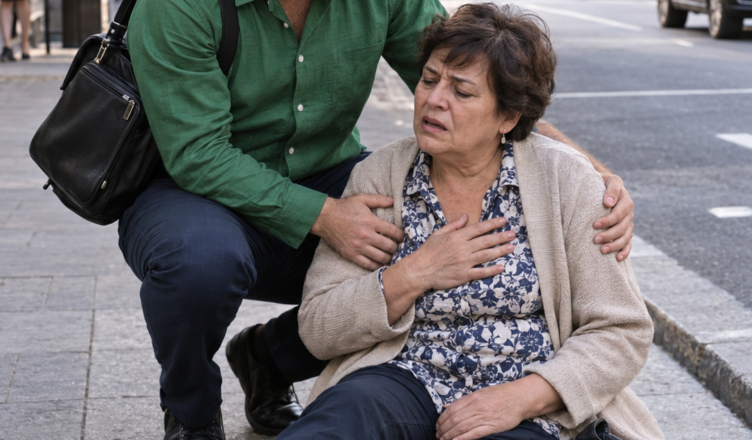
Then, while driving along a quiet road on the outskirts of the city, I noticed a car stopped near the curb.
A few yards farther ahead, there was a woman.
She was walking slowly, as though she were trying to make her way back to her vehicle.
Suddenly, she stopped.
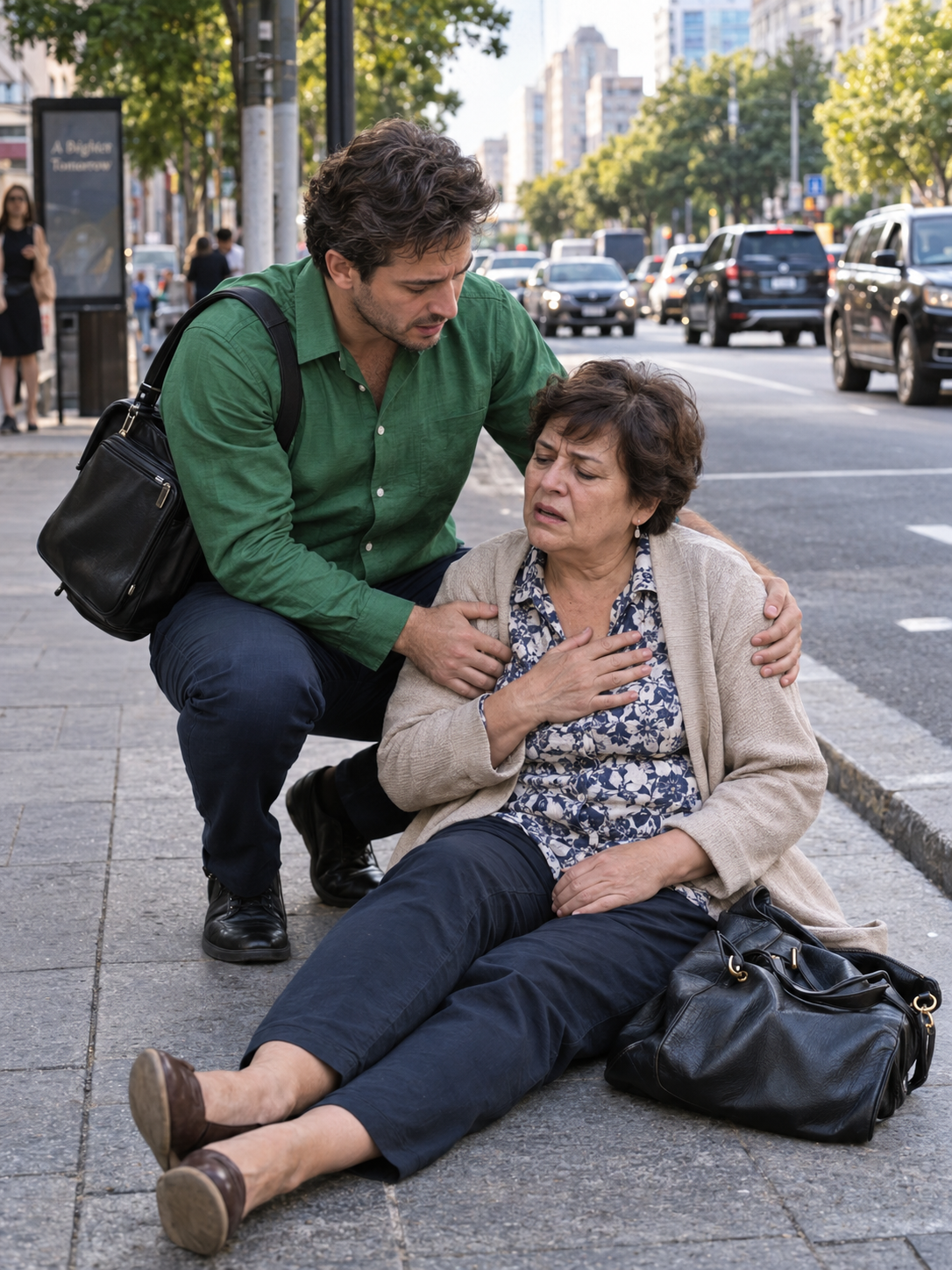
One hand went to her chest.
Her handbag slipped from her shoulder.
Then she lost her balance.
I hit the brakes almost instinctively.
I pulled over safely, switched on my hazard lights, and rushed toward her.
“Ma’am, can you hear me?”
She was conscious, but she looked confused and extremely weak.
I immediately called emergency services, followed the operator’s instructions, and stayed beside her to keep her calm.
She kept apologizing.
“I’m sorry I’m making you late,” she whispered.
“Don’t worry about me,” I told her. “I’m staying until help gets here.”
My phone began vibrating inside my jacket.
Once.
Then again.
Soon, several messages followed.
I knew exactly who was trying to reach me.
Nick.
I checked the time.
8:24.
There was no chance I would make the meeting on time now.
I considered calling the office, but the woman suddenly seemed disoriented again.
The phone could wait.
The paramedics arrived shortly afterward.
Once I knew she was safely in the hands of professionals, I returned to my car.
It was almost nine.
Seven missed calls.
I called Nick.
He answered immediately.
“Where are you?”
“I’m on my way. There was an emergency on the road.”
“The meeting has already started.”
“I know. I’ll explain when I get there.”
Silence.
Then his voice turned cold.
“Soon, there won’t be anything left to explain.”
He hung up.
I drove to the office with a knot in my stomach.
The moment I walked inside, I knew things had gone badly.
The conference room was empty.
The first slide of my presentation was still displayed on the large screen. Coffee cups, glasses of water, and abandoned folders remained scattered across the table.
The clients were gone.
Nick was waiting for me by the door.
“Finally.”
I put my bag down.
“I’m sorry. A woman collapsed on the road. She was alone. I called an ambulance and stayed with her until the paramedics arrived.”
Nick stared at me for several seconds.
“Did you know her?”
“No.”
“Was she a relative?”
“No.”
He slowly shook his head.
“So you missed the most important meeting we’ve had in months because of a complete stranger.”
“I didn’t choose to miss the meeting. I saw someone in trouble and stopped.”
“And the client walked out.”
“I could have presented as soon as I arrived.”
“They weren’t willing to wait.”
I took a deep breath.
“I regret what happened with the client. But I couldn’t watch a woman collapse and simply drive away as if I hadn’t seen anything.”
Nick answered immediately.
“You should have thought about your professional responsibilities.”
Those words hurt more than his tone.
For years, I had built my entire life around my job.
I had canceled family dinners to deal with problems nobody remembered the next morning. I answered emails on weekends. I trained new employees and rescued projects everyone else had already written off.
I never thought of it as sacrifice.
I thought it was simply the price of building a successful career.
“Nick, this is the first time I’ve ever been this late.”
“And you picked the worst possible day.”
“Because someone needed help.”
“The reason doesn’t change the consequences.”
He pointed toward my desk.
“Pack your things. You don’t work here anymore.”
For several seconds, I honestly thought he was trying to scare me.
He wasn’t.
I looked around at my coworkers.
Nobody said anything.
Some avoided my eyes. Others looked genuinely sorry.
“After everything I’ve done for this company?”
Nick looked down at the papers in his hands.
“The decision has been made.”
I didn’t argue.
I walked out of the building and returned to my car.
Only after closing the door did I realize my hands were shaking.
I thought about the mortgage.
The bills.
My two daughters.
Most of all, I wondered how I was going to tell my wife that I had left home that morning hoping for a promotion and would return only a few hours later unemployed.
I sat in the parking lot for nearly twenty minutes.
Eventually, I went back inside to collect my belongings.
When I reached my floor, a coworker named Marta approached me carrying a small box.
Inside were photographs, notebooks, a coffee mug, and a drawing my youngest daughter had made for me the year before.
“I thought it might be easier if you didn’t have to pack everything yourself,” she said.
“Thank you.”
Marta hesitated.
“I’m really sorry, Sebastian.”
I nodded.
Then I noticed an envelope sitting on my keyboard.
“That’s for you,” Marta said.
“Who left it?”
“I don’t know. A man came in a few minutes ago asking for the person who stopped to help a woman on the road this morning.”
I froze.
I opened the envelope.
Inside was a short note.
The woman was doing better.
Her family had learned that a stranger had stayed beside her until the ambulance arrived, and she wanted to thank me personally.
There was no promise of money.
No reward.
Just a name and a business contact.
Elena Valenti.
I didn’t call that day.
Instead, I went home and told my wife, Laura, everything.
I expected her to panic.
She remained quiet for several seconds before asking me one question.
“If you could go back to this morning knowing that you would lose your job, would you keep driving?”
I thought about it.
The answer was obvious.
“No. I’d still stop.”
Laura nodded.
“Then at least we know what kind of man came home today.”
Her words stayed with me all night.
The following morning, I called the number on the note.
Two days later, I was sitting across from Elena.
She looked much better, although she still seemed tired.
When I entered the room, she stood to greet me.
“Now I can finally thank you.”
“You really don’t have to.”
“I do.”
We spoke for a while about what had happened.
Then she asked what I did for a living.
I hesitated before answering.
“Until Tuesday, I worked in communications.”
She studied my face.
“You lost your job because you were late?”
I didn’t want to turn the conversation into a complaint about my former boss.
“Let’s just say missing that meeting had consequences.”
Elena didn’t push.
I assumed that would be the end of our conversation.
Then she asked me something unexpected.
“Did you like your job?”
I almost automatically said yes.
But I stopped myself.
Did I?
I loved developing strategies, solving problems, and working with teams.
But I had stopped loving the way my job had taken over every other part of my life.
“I like what I do,” I finally said. “I’m just not sure I liked where I was doing it anymore.”
Elena smiled.
“That’s an interesting answer.”
That was when I discovered she ran a family-owned company that worked with several businesses throughout the region.
She didn’t immediately offer me a job.
Strangely, I was relieved.
“I don’t want to hire you simply because you helped me,” she explained. “That wouldn’t be fair to you or the other candidates. But we are looking for someone with your experience. If you’re interested, I can forward your résumé to the people responsible for hiring. After that, you’ll have to convince them yourself.”
That was exactly what I wanted.
I didn’t need a gift.
I needed an opportunity.
So I accepted.
Two interviews and a practical assessment followed.
Nobody treated me like “the man who saved Elena.”
They questioned my experience.
They challenged my ideas.
They even asked me to completely rethink a proposal I had prepared.
When the final interview ended, I drove home convinced I hadn’t gotten the position.
Three days later, my phone rang.
They offered me a senior role in the communications department.
The salary was slightly higher than what I had been earning before.
But that wasn’t what convinced me.
The head of human resources said something I had never heard at my old company:
“We expect people to care about their work. But we also understand that their lives don’t disappear when they walk through the office doors.”
I accepted.
Over the following months, I rediscovered something I had almost forgotten.
It was possible to take your career seriously without living in constant fear of making one mistake.
I started getting home early enough to have dinner with my family.
I stopped checking my phone every ten minutes on Saturdays.
My daughters stopped asking whether I was “in another meeting.”
Slowly, I felt as though I had found my place in my own life again.
As for my old agency, there was no dramatic revenge.
Nick never came begging me to return.
The company didn’t collapse.
Our paths simply separated.
Months later, I ran into Marta during lunch.
She told me several employees had left and management was trying to change some of its practices.
I didn’t feel satisfaction.
That story no longer belonged to me.
Mine had truly begun at 8:17 that morning.
For years, I believed life-changing decisions always announced themselves clearly: a promotion, a major contract, an extraordinary opportunity.
I was wrong.
Sometimes they appear as a car stopped beside the road.
As a stranger who needs help.
As a meeting you suddenly realize you’ll never reach on time.
I don’t believe I did anything extraordinary that morning.
I simply made the choice that felt human.
It cost me my job.
For a few hours, I believed I had destroyed everything I had spent years building.
Now I understand that I had only lost something I had become so accustomed to that I had stopped asking whether it was actually making me happy.
Today, my daughter’s drawing still sits on my desk.
Beside it is a photograph of my family.
Whenever work becomes chaotic and everything feels urgent, I look at them.
And sometimes I remember that road.
Because that morning taught me something no presentation, promotion, or business meeting ever could.
A job matters.
A career matters.
A meeting can open or close certain doors.
But there are moments when life doesn’t ask us for strategies or calculations.
It simply asks us to decide what kind of person we want to be.
And sometimes, the detour we think we cannot afford becomes the very road that leads us back to what truly matters.
