
Three days before my husband and daughter ended up in the hospital, I caught my husband hiding an envelope in his desk.
I was walking down the hallway carrying a pile of clean laundry when I saw him quickly slide it into a drawer, almost as if he didn’t want me to know it existed.
I stopped.
“What’s that?”
For a moment, he said nothing. His expression changed, and his hand remained on the drawer.
“Something I need to check,” he finally replied. “I’d rather talk to you about it once I understand what’s going on.”
His answer did nothing to reassure me.
I was about to press him for an explanation when our ten-year-old daughter, Chloe, called for me from another room.
The moment passed.
Three days later, that same envelope was in the hands of the police.
My husband and daughter had both been rushed to the hospital.
And my sister was standing outside our house, unable to look me in the eye.
That was when I realized my husband hadn’t been trying to hide a secret from me.
He had been trying to discover just how deeply someone had worked their way into our private lives.
When the officers collected the envelope, one of them asked me to keep my distance while they examined what was inside.
But I still saw enough.
My name appeared on several documents.
There were copies of personal information, financial transactions I didn’t recognize, and signatures that looked enough like mine to fool anyone who had never actually watched me sign my name.
I looked at my sister.
She had been living with us for nearly two months.
She had told us she was going through a difficult period and needed somewhere to stay while she tried to rebuild her life.
I hadn’t hesitated.
I gave her our guest room.
We adjusted our routines to make space for her.
Chloe loved having her aunt in the house.
I thought I was simply helping someone I loved.
But while we were opening our home to her, she had quietly been learning how our lives worked.
Our schedules.
Our habits.
Where we kept important papers.
When the house was usually empty.
Eventually, my husband began noticing things that didn’t make sense.
He started checking certain information and quietly saving anything he thought might become important.
But even he didn’t yet understand how serious the situation was.
Neither did I.
“I was going to fix everything,” my sister suddenly said.
I stared at her.
“Fix what?”
She didn’t answer.
Later, I would learn that several financial actions had been carried out using my personal information without my knowledge.
But at that moment, money was the last thing on my mind.
My husband and daughter had just been taken to the hospital.
Both of them had been found inside our home in a frightening condition.
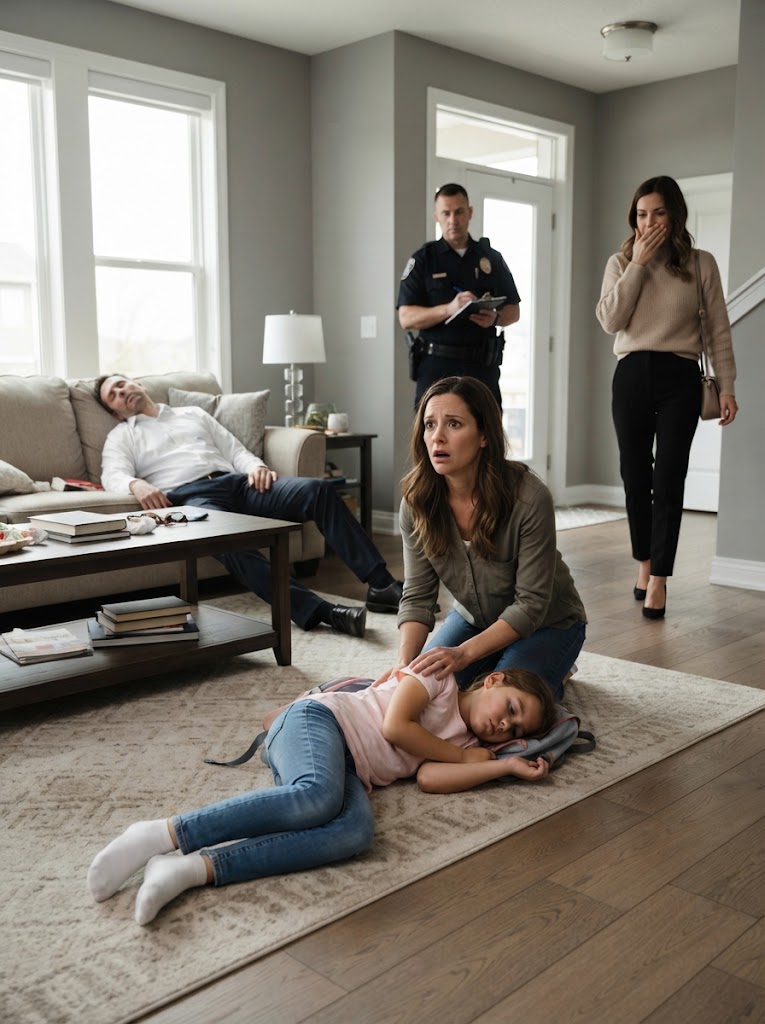
Chloe woke up first.
When I entered her hospital room, the first thing she asked was:
“Is Dad okay?”
I told her the doctors were monitoring him and that his condition was stable.
Only then did she seem able to breathe normally again.
A few minutes passed before she spoke again.
“Mom… Auntie was at the house.”
I immediately sat beside her.
Normally, Chloe would have stayed after school that afternoon for an activity, but it had been canceled at the last minute.
So she came home much earlier than anyone expected.
When she arrived, she noticed my sister’s car outside.
That surprised her because her aunt had sent a message earlier saying she would be busy somewhere else.
Chloe went inside.
She saw her aunt near the hallway.
“When she saw me, she looked really upset,” Chloe told me.
“Did she say anything?”
Chloe nodded.
“She asked why I was home already.”
My stomach tightened.
A short time later, Chloe heard a noise coming from another room.
She went to investigate.
That’s where she found her father on the floor.
She tried to help him, but soon she began feeling weak herself.
Despite that, Chloe managed to call for help using the device she wore on her wrist.
My sister left the house.
Investigators later determined that a dangerous substance had somehow ended up in an area of our home where it should never have been.
I didn’t want to hear every technical detail.
They didn’t matter to me.
The only thing I could think about was how much worse everything might have become if Chloe hadn’t managed to call for help.
My sister kept insisting that she had never intended to hurt anyone.
She claimed she had only wanted enough time to retrieve certain documents.
But one question wouldn’t leave my mind.
How had she known everyone’s schedule so precisely?
My husband regained consciousness that evening.
The first word he said was:
“Chloe?”
I moved closer to him.
“She’s awake. She’s okay.”
He closed his eyes in relief.
Part of me wanted to embrace him.
But I was still thinking about the envelope.
“How long have you known?”
He immediately understood what I meant.
“Three days.”
Anger surged through me.
For three days, my sister had continued living under our roof.
She had eaten meals with us.
Watched television with Chloe.
Asked whether she could stay a little longer.
And during all that time, my husband had suspected she was using information that belonged to me.
“Why didn’t you tell me?”
“Because I didn’t want to accuse your sister until I was certain.”
Then he explained how everything had begun.
A financial notice had arrived at our house with my name on it.
At first, he assumed it was an administrative mistake.
Then more strange things appeared.
Eventually, he discovered documents he couldn’t explain.
That was when he began making inquiries through the proper channels and keeping anything that might later prove useful.
“I thought I could figure out what was happening before I worried you,” he said.
I shook my head.
“You can’t protect me from something affecting my own life by keeping it from me.”
He didn’t argue.
“You’re right.”
It didn’t erase my anger.
But it started a conversation we should have had much sooner.
The following morning, an investigator came to speak with us.
My sister was being held while the investigation continued.
We also learned that my husband had taken an important precaution.
The envelope wasn’t the only place where he’d kept the information.
He had already reported some of the suspicious activity to the relevant institutions, and copies of the most important evidence had been stored separately.
Whatever reason my sister had for desperately wanting that envelope, making it disappear wouldn’t have erased what had already been documented.
For the first time since Chloe’s emergency call, I felt as though I could breathe again.
I thought the worst discoveries were behind us.
I was wrong.
Two days later, all three of us were back home.
Chloe was eating cereal in the kitchen.
My husband was resting on the sofa.
I was trying to make our lives feel normal again when my phone rang.
It was the investigator.
He asked me several questions about the personal documents we kept in the house.
Then he mentioned Chloe.
“Were any documents belonging to your daughter kept in your office?”
I froze.
“Yes. Why?”
There was a short silence.
Then he told me investigators had found photographs on my sister’s phone containing Chloe’s personal information.
The photographs hadn’t been taken on the day of the incident.
They were several weeks old.
Investigators had also discovered drafts of paperwork that appeared to use some of that information.
I slowly sat down at the kitchen table.
Chloe looked up from her cereal.
Until that moment, part of me had still been searching for the sister I remembered from childhood inside the woman who had done all of this.
I remembered the bedroom we’d shared.
The nights we’d spent talking for hours.
The way she’d comforted me after our father died.
I was still trying to find an explanation.
Maybe it was debt.
Maybe fear.
Maybe desperation.
But Chloe was ten years old.
And my sister had collected information about my child that she had absolutely no right to possess.
Something inside me changed permanently.
I stopped searching for explanations that could somehow make her choices seem less serious.
From that moment forward, my priority became very simple.
Protect my daughter.
I requested every appropriate legal measure available to prevent unauthorized contact.
I also stopped responding to relatives who insisted that I needed to hear “her side of the story.”
Desperation can sometimes explain why someone makes a terrible decision.
It doesn’t make that decision acceptable.
We had opened our home to my sister because she said she needed help.
She had turned our trust into access to our private lives.
The months that followed were nothing like stories where everything gets resolved in a single courtroom scene.
There were investigations.
Administrative procedures.
Additional safeguards to put in place.
Difficult conversations.
And a little girl who, for quite some time, turned toward the window whenever an unfamiliar car slowed down outside our house.
There was also something I needed to resolve with my husband.
He wasn’t responsible for the choices my sister had made.
But he had made a mistake by believing silence could protect me.
One evening, he said:
“I thought I could solve it before it became your problem.”
I looked at him.
“It was already my problem.”
He lowered his eyes.
“I know.”
Those two words meant more to me than a long explanation ever could.
From that point on, we established an important rule in our marriage.
There would never again be secrets hidden behind the words, “I’m doing this to protect you.”
If something affected our family, we would talk about it.
Even when the conversation was uncomfortable.
Especially when it was uncomfortable.
Little by little, Chloe began to feel safe again.
But she never wanted to wear the jacket she’d had on that day.
I didn’t ask her why.
I simply put it away.
A few weeks later, while we were reorganizing the house, she found a small brass tray that used to sit near our entrance.
Before everything happened, we had used it to hold everyday objects.
Afterward, I couldn’t stand looking at it.
Chloe picked it up.
“Can I have this?”
I looked at her curiously.
“What for?”
“My bracelets.”
So I gave it to her.
A lot has changed in our home since then.
We protect important information much more carefully.
We’ve changed our routines, our access, and some of the habits we once took for granted.
And we learned something I wish we’d never had to learn.
Being family doesn’t automatically give someone the right to enter every corner of your life.
Trust isn’t a permanent key.
It has to be respected.
Today, that little brass tray sits on Chloe’s dresser.
It’s filled with friendship bracelets, hair clips, polished stones, and a plastic ring that, for reasons I still don’t understand, she considers one of her greatest treasures.
Sometimes, when I walk past her room, I hear the soft sound of a bracelet dropping into the tray.
For a long time, that sound would have reminded me only of everything my sister tried to take from us.
Now it reminds me of something else.
My sister knew our routines because we had welcomed her into our home.
She mistook our trust for a right.
It never was.
Chloe found a new purpose for that little tray.
And in a way, we did the same with our lives.
We can’t change what happened.
But we can decide who enters our home.
We can decide what we share.
We can decide where our boundaries begin.
And most importantly, we are far more careful now about who we choose to give our keys to.
