Traveling alone with two children can be exhausting.
But that day, I realized that the hardest part of traveling isn’t always the luggage, the schedules, or the usual last-minute problems.
Sometimes, all it takes is one unexpected moment inside an airplane to remind you how closely children can observe the world around them.
Our flight was from Chicago to Orlando.
My son, Leo, was only six weeks old.
My daughter, Maya, was ten.
My husband was away for work, so I was traveling alone with both children.
I had tried to prepare for everything.
I packed everything Leo might need.
I checked our travel documents several times.
I chose seats that were close together and arrived at the airport early enough to avoid unnecessary stress.
I thought being organized would help us avoid problems.
I was wrong.
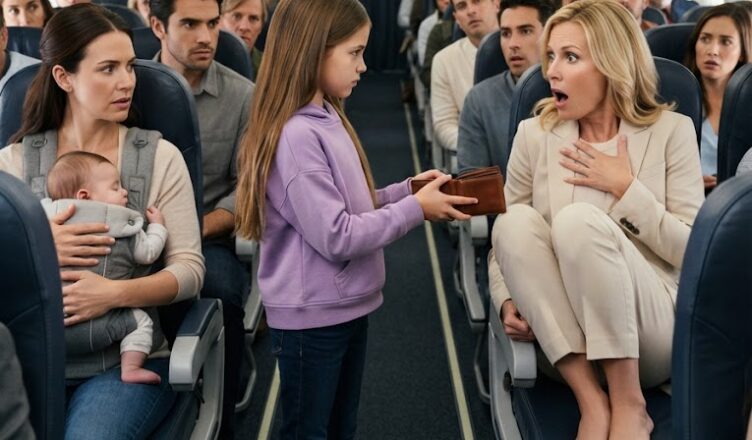
When we reached our row, I immediately noticed something unusual.
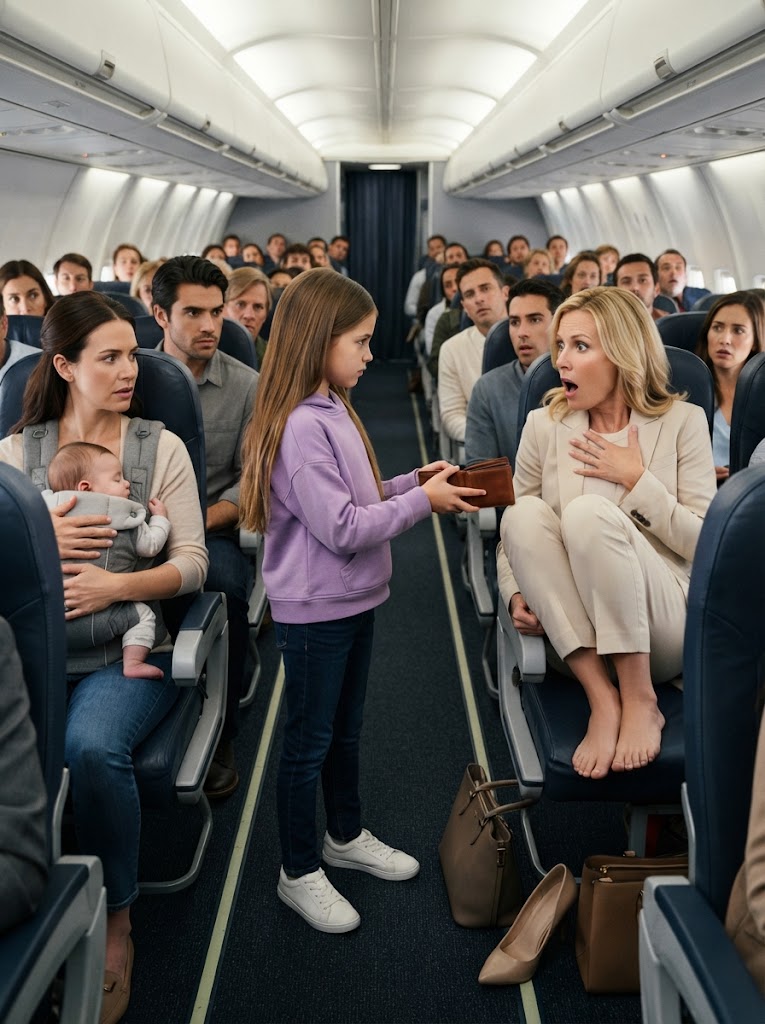
A passenger was already sitting in one of the seats assigned to me.
Her belongings were arranged around her as though she intended to stay there.
I checked my boarding information again.
There was no mistake.
The seat belonged to me.
I approached her calmly and explained the situation.
I expected it to be a simple misunderstanding that would be resolved within a few moments.
Instead, the woman seemed unwilling to move.
She looked at my baby.
Then she looked at Maya.
Her reaction made an ordinary seating issue feel much more uncomfortable.
I didn’t want to argue in front of the children.
I was holding Leo, Maya was standing beside me, and an entire cabin of passengers was waiting for boarding to continue.
Eventually, a member of the crew came over to check the information.
The details were clear.
Still, the conversation continued for a little while.
The passenger seemed to believe that I would eventually give up my seat simply to avoid an argument.
For a moment, I considered doing exactly that.
Maybe it would have been easier.
But I needed to remain close to both of my children, especially because Leo was still so young.
Maya remained quiet.
I knew her well enough to recognize the difference between ordinary curiosity and the expression she had when something genuinely caught her attention.
This time, she was watching.
She wasn’t speaking.
She was simply paying attention to what was happening around her.
Eventually, the seating issue was resolved and we were able to settle in.
I thought the problem was over.
But a few minutes later, I noticed that Maya was still looking quietly toward the area where the other passenger was sitting.
Then her expression changed.
She no longer looked merely curious.
She looked focused.
I leaned toward her and quietly asked what she had noticed.
Maya hesitated before answering.
She told me that she had noticed an object near the passenger, partly covered by her coat, and that the way the woman appeared to be keeping it out of sight seemed unusual to her.
Maya did not claim to know what the object was.
She didn’t say the woman had done anything wrong.
She simply described what she had seen.
I immediately told her not to approach the passenger or touch anything.
Then I quietly informed a member of the crew.
It was the safest decision.
Maya stayed in her seat.
I did not try to examine the object myself.
The crew handled the matter according to their procedures.
A short time later, a crew member returned and told us that the situation was under control.
There was no dramatic scene.
Nobody was hurt.
But that moment completely changed the way I understood what had happened.
Until then, I had thought the problem was simply a disagreement over a seat.
Maya had noticed a detail that I had missed.
And what impressed me most wasn’t only what she had noticed.
It was how she responded.
She was ten years old.
She could have become frightened.
She could have started telling other passengers.
She could have tried to investigate on her own.
She did none of those things.
She observed.
She waited.
And she spoke to an adult she trusted.
After we arrived in Orlando, I kept thinking about it.
For years, I had worried about protecting my daughter from everything that might make her uncomfortable.
I wondered whether she would recognize an unusual situation.
I wondered whether she would have enough confidence to speak when something didn’t seem right.
That trip gave me an answer.
Maya didn’t need to be the loudest person in the room.
She didn’t need to attract attention.
She simply needed to know how to observe and when it was appropriate to ask for help.
That was a kind of courage I hadn’t fully appreciated before.
The experience also reminded me of something important about raising children.
Teaching them to be kind doesn’t mean teaching them to accept every situation.
Being respectful doesn’t mean ignoring their own boundaries.
And staying calm doesn’t mean remaining silent when something feels unusual.
You can be polite and still have boundaries.
You can be cautious without accusing anyone.
You can notice something unusual without immediately turning an impression into a conclusion.
And most importantly, you can ask for help when you don’t know what to do.
Maya didn’t try to solve the situation herself.
And that was exactly the right choice.
She noticed something that concerned her, kept her distance, and told a trusted adult.
The rest belonged to the people responsible for handling the situation.
When we finally reached our destination, Maya took her little brother’s hand and smiled at me.
She seemed ready to forget the entire incident.
I knew I wouldn’t.
Not because of the seat.
Not because of the disagreement.
And not because of the other passenger.
I would remember that flight because of my daughter.
That day, I realized that the little girl I thought I always needed to protect was already learning how to look after herself in the right way: by paying attention, staying calm, and knowing when to ask for help.
Children sometimes notice details adults miss.
But the real lesson isn’t to teach them to be suspicious of everyone.
It’s to teach them to stay aware without living in fear, to be cautious without judging others, and to feel confident enough to speak when something seems unusual.
And that is what I will remember most about that journey.
