The cathedral was filled with nearly two hundred guests when Charles Bennett realized he could not marry the woman standing beside him.
Only minutes earlier, everything had looked perfect.
White flowers lined the aisle. Candles glowed beneath the stained-glass windows, and soft music filled the enormous room.
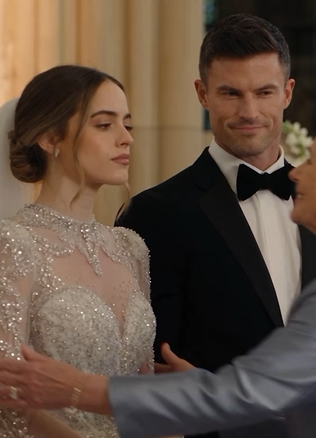
Charles, thirty-four, stood at the altar in a black tuxedo beside his bride, Vanessa Hale.
Then his mother approached them.
Margaret Bennett was sixty-seven and wore a simple blue dress she had spent weeks choosing for the occasion.
Her eyes were already wet with happy tears.
She opened her arms toward Vanessa.
Vanessa stepped backward.
Margaret stopped.
For a moment, everyone assumed she was worried about her expensive wedding dress.
Then Vanessa raised her hand.
“Please don’t hug me.”
Margaret looked confused.
Vanessa glanced at her clothing and added a dismissive comment about the smell of the farm where Margaret still worked several mornings a week.
The cathedral became painfully quiet.
Margaret lowered her arms.
Charles stared at his bride.
“Vanessa.”
She looked at him.
“What?”
“Apologize to my mother.”
Vanessa tried to dismiss what had happened as a harmless joke.
Charles didn’t laugh.
For months, he had ignored small moments that now suddenly seemed much more important.
Comments about his mother’s modest home.
Questions about why Margaret needed to attend certain family events.
Suggestions that Charles should buy her more expensive clothes.
He had explained each incident away.
Now he couldn’t.
Charles looked at Vanessa’s engagement ring.
“Give me the ring.”
Her expression changed.
“Charles, don’t be ridiculous.”
“I mean it.”
“You’re going to destroy our wedding over one comment?”
Charles remained calm.
“No. I’m stopping because that comment made me finally understand something I should have noticed much earlier.”
The guests watched in stunned silence.
Vanessa slowly removed the ring.
Charles closed his hand around it.
“The wedding is over.”
Margaret immediately stepped toward him.
“Charles, don’t do this because of me.”
He took her hands.
“I’m not doing it because of one insult, Mom. I’m doing it because I finally paid attention.”
And there was a reason Charles could not simply ignore what Vanessa had said.
Twenty-eight years earlier, Margaret’s life had fallen apart.
Charles had been only six when his father disappeared from their home.
Margaret was suddenly left with a child, a mortgage and almost no savings.
She took whatever work she could find.
She cleaned offices early in the morning.
She worked in a cafeteria.
Several evenings each week, she helped at a dairy farm outside town.
Years later, Charles still remembered waiting for her one night at the kitchen table.
He was nine.
Margaret came home exhausted, her hands rough from work.
“Why do you work all the time?” he asked.
She smiled.
“So one day you won’t have to.”
Charles never forgot those words.
Margaret somehow found money for school activities.
She attended every important event.
When Charles received a college scholarship, she drove him to campus in an aging car that barely completed the journey.
Years later, when Charles wanted to start a logistics company with a friend, Margaret offered him almost everything she had managed to save.
Charles tried to refuse.
She insisted.
“Build something worthwhile.”
He did.
The business eventually grew to employ hundreds of people.
When Charles finally had enough money to buy an expensive home, the first house he purchased wasn’t for himself.
It was for Margaret.
There was only one thing she refused to give up.
The farm.
“You don’t need to work there anymore,” Charles repeatedly told her.
“I know.”
“Then why stay?”
Margaret always gave the same answer.
“Because when I desperately needed work, they gave me a chance.”
So she continued helping there.
The scent Vanessa had mocked was something Charles remembered from childhood.
To Vanessa, it represented something embarrassing.
To Charles, it represented every sacrifice that had allowed him to become the man standing at the altar.
That was why he walked out of the cathedral holding his mother’s hand.
Six Months Later
Charles expected to wake up one morning overwhelmed by regret.
That morning never came.
He felt sadness.
He felt embarrassment about how publicly everything had ended.
He occasionally wondered whether he could have handled things differently.
But he never regretted refusing to begin a marriage after realizing how differently he and Vanessa viewed respect and family.
Vanessa moved away.
Months later, she called him.
“I’ve been thinking about what your mother said,” she admitted.
Then she apologized.
Charles believed she meant it.
But an apology did not automatically mean they should rebuild their relationship.
Sometimes forgiveness meant letting each other move forward without carrying the same anger.
They wished each other well.
And their lives separated.
Then, one spring morning, Margaret called Charles.
“The north fence is broken.”
Charles laughed.
“Good morning, Mom.”
“I need help.”
“At the farm?”
“Unless you’ve secretly purchased another farm.”
Charles drove out that afternoon.
While repairing the fence, he noticed a pickup truck stop near the barn.
A woman climbed out carrying a cardboard box.
Her name was Anna.
She was thirty-one, worked as a veterinary nurse and had grown up around the farm.
Margaret introduced them.
Anna looked down at Charles’s expensive shoes, now covered in mud.
“Interesting footwear for farm work.”
Charles glanced at them.
“Nobody told me this was an official fence emergency.”
Anna laughed.
And unexpectedly, so did he.
They met again.
Then again.
Nothing dramatic happened.
That was what Charles liked most.
There were no carefully arranged society dinners.
No pressure to impress anyone.
Sometimes they drank coffee near the barn.
Sometimes they walked through the fields.
Anna treated Margaret with the same warmth whether Charles was present or not.
Slowly, friendship became something more.
Two Years Later
Charles returned to the same cathedral.
This time there were only forty-three guests.
No extravagant decorations.
No enormous floral installations.
Anna wore her grandmother’s restored wedding dress.
Margaret wore the same blue dress she had worn to Charles’s cancelled wedding.
“This dress has history,” she said when Charles offered to buy another.
Before the ceremony, Anna stood beside Margaret.
Then she handed her bouquet to someone else and opened her arms.
“Well?” Anna said. “Are you going to hug me?”
Margaret laughed.
Then she embraced her.
Anna whispered something into her ear.
Margaret immediately began crying.
Charles later asked what Anna had said.
Eventually Margaret told him.
“Thank you for raising the man I’m about to marry.”
Charles never forgot those words either.
Five Years Later
Charles and Anna eventually became parents to Sophie and Daniel.
Margaret adored being a grandmother.
She also treated Charles’s parenting rules as suggestions.
“No cookies before dinner,” he would tell her.
“Of course not.”
Ten minutes later, Sophie would be hiding behind the sofa with a cookie.
“Grandma gave it to me.”
Margaret would deny everything.
Life was ordinary.
Warm.
Busy.
Then the farm encountered financial problems.
Developers had begun purchasing nearby properties, and the owners received an attractive offer to sell.
Margaret was devastated.
“This place saved us,” she told Charles.
He understood.
The farm had given her more than a paycheck.
It had given her dignity when her life had been collapsing.
Charles and Anna decided to preserve it.
They helped transform the property into a training center supporting parents trying to return to stable employment.
The program provided paid training and practical family support.
They named the project after Margaret.
She was furious.
“You should have asked me.”
“You would have refused.”
“Exactly.”
Charles smiled.
“That’s why we didn’t.”
Over the following years, dozens of families passed through the program.
Then Charles saw a familiar name among the applications.
Vanessa Hale.
Her circumstances had changed considerably.
She was now raising a young daughter named Lily and had applied for the same program available to everyone else.
Charles didn’t know how to react.
He showed Anna.
“What should I do?”
Anna read the application.
“Don’t punish her for your history.”
“I’m not planning to.”
“I know. But don’t give her special treatment because you feel sorry for her either.”
“So?”
“Treat her exactly like everyone else.”
That was what he did.
Vanessa went through the normal process and was accepted.
For months, they didn’t see each other.
Then one rainy afternoon, Charles visited the center.
A little girl in bright yellow rain boots stood near the barn.
“Are you Mr. Bennett?”
Charles smiled.
“I am.”
“My mommy says you own everything.”
He laughed.
“Your mommy is exaggerating.”
Then Vanessa appeared.
They both froze.
Years had passed since their last meeting.
“This is Lily,” Vanessa said.
Charles smiled at the little girl.
“Those are impressive boots.”
“They’re waterproof,” Lily announced proudly.
After Lily ran away, Vanessa looked toward the barn.
“I saw your mother.”
Charles waited.
“She remembered me.”
“I’m sure she did.”
“I apologized to her.”
Charles studied Vanessa’s face.
“What did she say?”
Vanessa’s eyes filled with tears.
“She said she’d forgiven me a long time ago.”
Charles smiled.
“That sounds like Mom.”
“I didn’t deserve it.”
“Forgiveness doesn’t always work according to what someone deserves.”
Vanessa looked toward her daughter.
Then she said something Charles never expected.
“I’m glad you stopped our wedding.”
He stared at her.
“If you hadn’t,” she continued, “maybe neither of us would have changed in the ways we needed to.”
There was no romantic reunion.
No dramatic reconciliation.
Just two people finally able to look at their past without trying to rewrite it.
They shook hands.
And continued with their separate lives.
Fifteen Years After the Cancelled Wedding
Margaret died peacefully at eighty-two.
Charles expected perhaps a hundred people at her funeral.
More than four hundred arrived.
Former coworkers.
Families from the training center.
Farm workers.
Parents Margaret had quietly helped.
Children she had cared for.
Near the back sat Vanessa and Lily, now grown.
After the service, Vanessa approached Charles and handed him a small blue envelope.
“Your mother asked me to give this to you.”
That evening, Charles opened it.
Inside was a handwritten letter.
Margaret told him not to spend too much time grieving.
She wrote about watching him become a businessman, a husband and a father.
Then she explained something she had never told him.
On the day of the cancelled wedding, Vanessa’s comment had not truly embarrassed her.
What frightened Margaret was the possibility that Charles might remain silent because he was afraid of losing the future he had planned.
But he hadn’t.
Margaret wrote that Charles believed he had been defending his mother that day.
In her eyes, something else had happened.
He had decided what kind of person he wanted to be.
Then she wrote:
Sometimes the day that appears to destroy your future is simply opening a door you never knew existed.
Charles sat quietly with the letter.
Then he laughed through his tears.
Anna found him a few minutes later.
“What did she say?”
Charles handed her the pages.
Outside, Sophie and Daniel were arguing in the backyard.
The house was noisy.
Warm.
Alive.
Charles looked toward a framed photograph on the mantel.
It showed his wedding to Anna.
Margaret stood between them in that old blue dress, laughing.
For years, people had remembered Charles as the man whose first wedding ended at the altar.
But that was no longer how he remembered that day.
He remembered it as the moment one planned future ended and another became possible.
The cathedral doors closing behind him had not marked the end of his story.
They had opened the way to the life he eventually chose to build.
