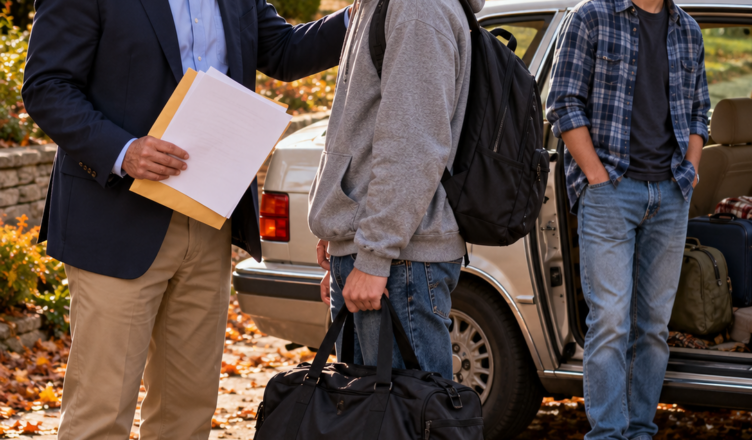
On my eighteenth birthday, my father told me I could no longer live under his roof.
It was a Tuesday.
I had three months left before graduating from high school, and I had just discovered that the $3,000 I’d saved by working after school had disappeared.
Nine days later, I was behind a restaurant, hungry and stranded with a broken-down car.
That was when a stranger said my name.
“Caleb Vance? I finally found you.”
I couldn’t yet imagine that this encounter would make me question everything my father had ever told me about our family.
That morning, I walked into the kitchen hoping to get at least a birthday greeting.
There was no cake or card.
My father was sitting at the table with his wife. My half-brother watched them in silence.
“Sit down, Caleb,” my father ordered.
I did.
“You’re eighteen today. You’re an adult now, and we’ve decided it’s time for you to learn to take care of yourself.”
At first, I thought he was going to give me another lecture about responsibility.
Then he pointed to the door.
“You have to leave.”
I stared at him.
“Today?”
“Yes.”
“But I haven’t even finished high school.”
My father shrugged.
“You’ll figure something out.”
His wife stepped in with a calm smile.
“We’ve already packed your things.”
Three large plastic bags were waiting near the entrance.
They held my clothes, a few books, and my personal belongings.
My whole life seemed to fit into three bags.
Then I thought about my savings.
Ever since I was fifteen, I’d worked whenever I could: shifts at the supermarket, washing dishes in restaurants, and weekends spent working instead of hanging out with my friends.
I’d managed to save a little over $3,000.
That money was supposed to help cover my first expenses after high school.
“What about my savings?” I asked.
My father didn’t even look surprised.
“We used it.”
My stomach tightened.
“Used it for what?”
“Family expenses. Bills, your brother’s college applications, and other things.”
“But I earned that money.”
“You’ve lived here for eighteen years,” he replied. “Consider it your contribution.”
I couldn’t think of anything to say.
I picked up my bags and walked out.
As I shut the door of my old sedan, I tried to convince myself I wouldn’t cry.
I lasted only a few seconds.
For nine days, my car was all I had.
I slept in it, kept my clothes there, and tried to find a little peace.
I kept going to school because I didn’t want to give up on graduating.
I arrived early, washed up in the locker rooms, and tried to act normal.
My classmates talked about exams, parties, and their plans for the summer.
I thought about where I’d park my car to sleep.
I saved part of my school lunch for the evening.
I tried to spend as little as possible.
I didn’t know whom to ask for help, and I was ashamed to explain what had happened.
On the ninth day, as I looked for a quiet place to pull over, the engine began to lose power.
I barely managed to reach a small road behind several restaurants.
I tried to start the car again.
Nothing.
I sat behind the wheel, staring at the dashboard.
I was hungry, exhausted, and had no idea where to go.
Finally, I got out.
Behind one of the restaurants, I saw several dumpsters near the service entrance.
I walked toward them, hoping to find something to eat.
That was when I heard a voice.
“Are you Caleb Vance?”
I spun around.
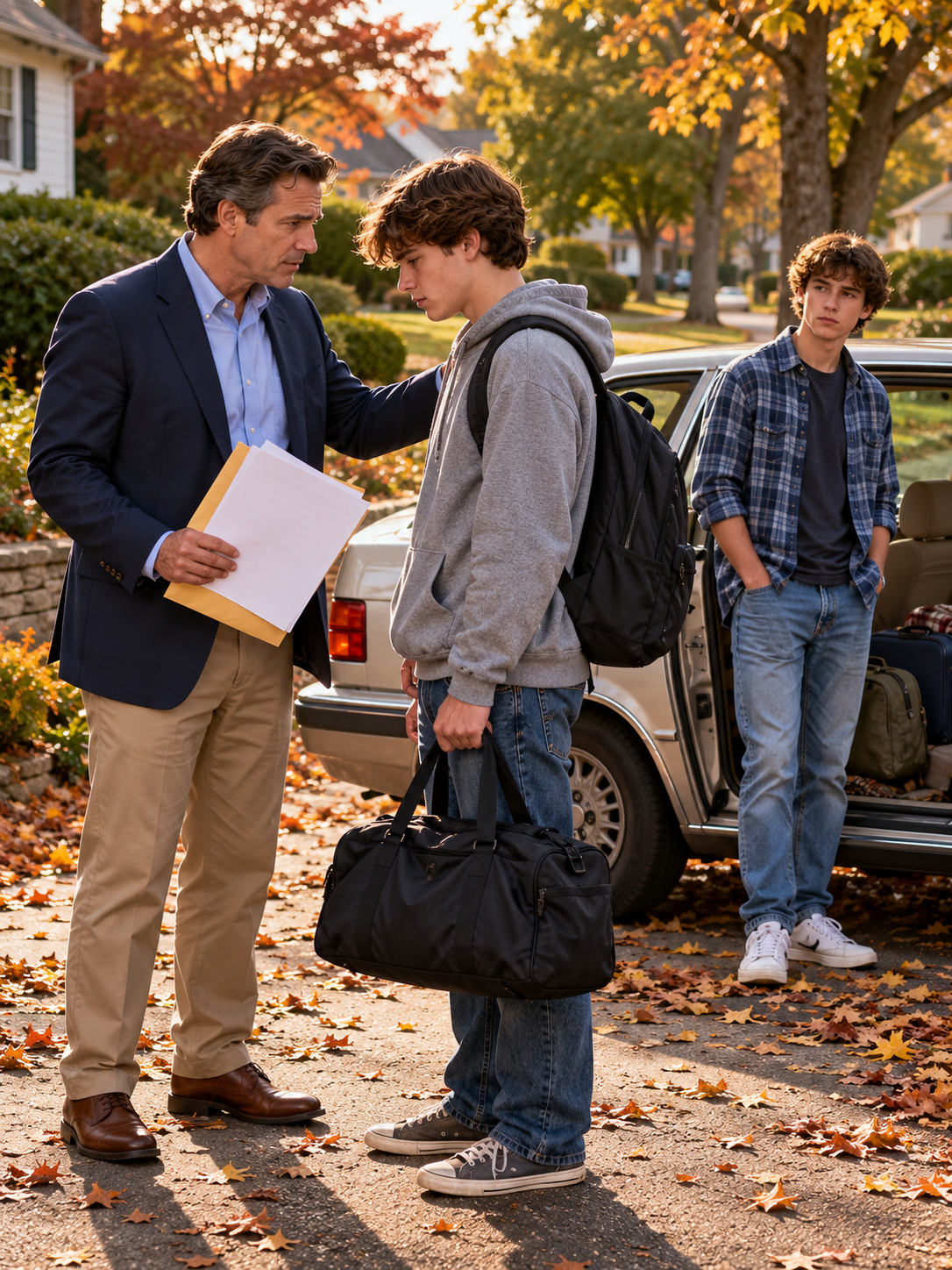
A man in his fifties stood in front of me, wearing an elegant suit. He carried a leather briefcase and looked completely out of place in that alley.
“Who wants to know?” I asked.
The man pulled out a business card.
“Arthur Kingsley. I’m a lawyer. I’ve been looking for you for several days.”
I looked at his card, then at his face.
“Why?”
“I represent the interests of the Edward Vance family.”
The name sounded familiar.
“Edward Vance was my grandfather.”
Arthur nodded.
“Exactly.”
“But he died before I was born.”
The man studied me carefully.
“Who told you that?”
“My father.”
Arthur was silent for a moment.
Then he said something I’ll never forget.
“Caleb, your grandfather died only a few weeks ago.”
It felt as if all the street noise had vanished.
“That’s impossible.”
“I understand this is hard to believe.”
“My father always told me he was dead.”
I’d never received a letter from my grandfather.
I didn’t know of any photographs, phone calls, or visits.
For eighteen years, I’d believed Edward Vance had died long before I was born.
“Why would my father lie to me?” I asked.
Arthur glanced at my broken-down car.
“That’s an important question. And I think some documents may help you understand.”
He opened his briefcase.
“But first, I need to explain why I was looking for you.”
He showed me several papers.
Edward Vance had made arrangements in his will that directly concerned me.
He owned a house, several bank accounts, and shares in a company called Vance Holdings.
According to the documents Arthur showed me, I was the primary beneficiary of his estate.
My father, however, was not listed among the people designated to receive those assets.
“Are you saying my grandfather left all of that to me?”
“That’s what his will says. Of course, some legal procedures and checks still need to be completed.”
I looked at him, unable to speak.
A few minutes earlier, I’d been searching for something to eat behind a restaurant.
Now, a man I’d never met was telling me about an inheritance I couldn’t even imagine.
I should have been happy.
But mostly, I was confused.
“If my grandfather was alive, why did he never try to see me?”
Arthur slowly closed a folder.
“From what I’ve been able to piece together, there were difficulties in the family relationships. I’d rather not draw conclusions for you.”
Then he took out a brown envelope.
My full name was written on it.
Caleb Vance.
“Your grandfather left this for you.”
I took it in both hands.
“What’s inside?”
“A letter and some instructions concerning his estate.”
I hesitated.
“Is there a condition?”
“There are some provisions you’ll need to read carefully. We can discuss them together, if you’d like.”
I looked at the envelope again.
My name was written in neat handwriting.
For the first time in my life, I was holding something from the grandfather I’d always believed was dead.
“Arthur… why did my father hide all this from me?”
The lawyer looked me straight in the eye.
“I can’t say for certain what your father was thinking. But Edward left information about your family’s past that he thought was important for you to know.”
My hands began to feel cold.
“What kind of information?”
Arthur pointed to the envelope.
“I think it’s better for you to find out for yourself.”
I looked down.
Nine days earlier, I’d lost my home.
That afternoon, I’d learned that the grandfather I thought was dead had been alive all those years.
And now I was holding a letter that might explain why we’d never met.
I slowly slipped a finger under the edge of the envelope.
I didn’t yet know what I’d find inside. But I was certain of one thing: after reading that letter, I would never see my family’s story the same way again.
END OF PART 1. THE STORY CONTINUES IN PART 2. GO BACK TO THE COMMENTS AND CLICK THE PART 2 LINK TO FIND OUT WHAT HAPPENS NEXT.
