“Teenagers always exaggerate.”
Those were the words Robert repeated whenever I tried to explain that something was seriously wrong with our daughter.
“She’s stressed about school,” he would say. “We’re not spending thousands of dollars because she wants attention.”
But a mother notices the things other people overlook.
I had watched Maya change over the previous weeks. She was constantly exhausted. She fell asleep on the couch before dinner, sometimes without even taking off her shoes. Her clothes had begun hanging loosely from her frame, and she would quietly press a hand against her stomach whenever she thought nobody was looking.
The worst part was the fear in her eyes.
“Mom,” she had whispered several times, “my stomach really hurts.”
I could no longer convince myself that it was nothing.
Then, at exactly 2:13 on a Monday morning, a faint sound woke me.
It wasn’t a scream.
It was a weak, trembling breath coming from Maya’s bedroom.
I rushed down the hallway and found her curled beneath the soft light of her desk lamp. She was holding her stomach with both arms, her face pale and wet with tears.
When she saw me, she slowly lifted her head.
“Mom…”
I dropped beside her.
“I’m here, sweetheart.”
“Please… make it stop hurting.”
Those words changed everything.
Until that moment, I had still been afraid of arguing with Robert. I was afraid of the medical bills, afraid of being accused of overreacting, and afraid of what might happen if I went against him.
But looking at my daughter, none of that mattered anymore.
The next afternoon, while Robert was at work, I picked Maya up from school.
She walked toward the car slowly, one hand pressed against her abdomen.
Neither of us said much during the drive.
She stared silently through the passenger window as the familiar streets passed by: schools, stores, traffic lights, and people going about ordinary afternoons.
I kept glancing at her.
She looked smaller than she had only a few months earlier.
I drove straight to Riverside Medical Center.
At the hospital, a receptionist handed me a stack of forms. I signed the paperwork, completed the medical history, and made sure the staff knew exactly what symptoms Maya had been experiencing.
A nurse checked her vital signs and placed a hospital wristband around her wrist.
Within the hour, the doctors ordered blood tests and an ultrasound.
Then my phone buzzed.
Robert: Where are you?
I stared at the message.
For years, fear had controlled my decisions.
This time, I turned the phone face down.
My daughter needed me more than I needed Robert’s approval.
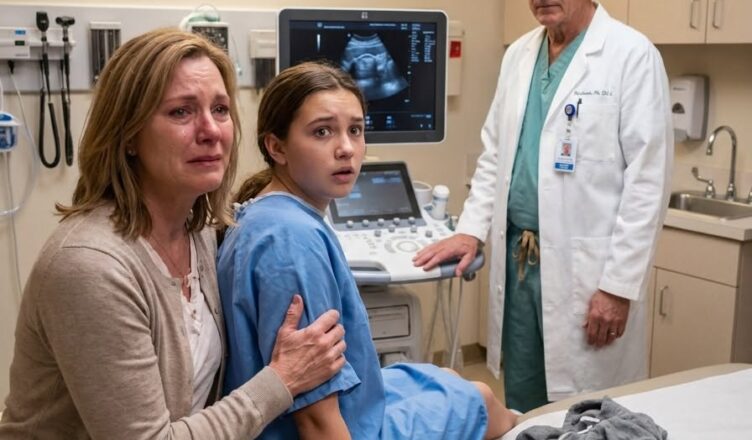
A short while later, Maya was lying quietly on the examination table beneath a thin paper blanket.
The ultrasound machine hummed softly in the background as the technician moved the probe carefully across her abdomen.
At first, the technician’s expression remained neutral.
Then she became unusually quiet.
She captured one image.
Then another.
She reviewed the screen several times before saving the scans and stepping out of the room.
“The doctor will be with you shortly,” she said.
Seven minutes later, Dr. Lawson entered carrying Maya’s medical file.
The moment I saw his expression, my stomach tightened.
He wasn’t smiling.
He wasn’t alarmed either.
He simply looked serious.
“Mrs. Thorne,” he said gently, “there’s something we need to discuss.”
Maya slowly pushed herself upright.
“Am I in trouble?”
I immediately reached for her hand.
“No, sweetheart. You’re not in trouble.”
Dr. Lawson glanced at the ultrasound images again.
Then he looked at me.
“The scan shows something we need to investigate further.”
The room suddenly felt much smaller.
“What did you find?” I asked.
Instead of answering immediately, he turned the monitor toward us.
A pale shape appeared on the screen.
Maya tightened her grip around my hand.
Dr. Lawson studied the image for another moment before speaking.
“There is an abnormal finding inside her abdomen, but we need additional tests before we can determine exactly what it is.”
My heart began pounding.
I looked at my daughter, then back at the doctor.
For the first time, I realized how serious her symptoms might have been.
But Dr. Lawson wasn’t finished.
“There is one important thing we need to confirm before I explain what we’re seeing.”
I swallowed hard.
“What is it?”
He looked at Maya’s file.
Then he raised his eyes toward me.
“And I think you should know that some of the information in her medical history doesn’t match what we’re seeing today.”
My blood ran cold.
Because that meant someone had either missed something…
or someone had deliberately kept something from us.
