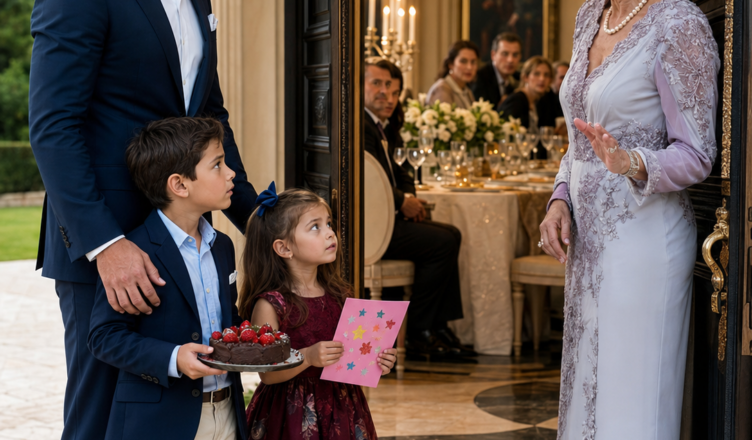
When Marcos arrived at his parents’ house to celebrate his mother’s 70th birthday, he had no idea that the day would permanently change his relationship with his family.
He had brought a cake and a small surprise prepared by his children.
Seven-year-old Sofia held a card decorated with hearts, purple glitter, and an old photograph of her grandmother taken on a beach in Veracruz.
Ten-year-old Tomás carefully carried the box containing the cake he had personally chosen from one of his grandmother’s favorite bakeries.
But the moment they reached the door, Marcos’s mother said something that left everyone speechless.
—There is no room at the table for your children.
Marcos thought he had heard her wrong.
—Mom, you invited us.
Doña Graciela lowered her voice.
—Yes, son. But your sister arrived before you with her children. They’re already seated.
From the doorway, Marcos could see the dining room.
The long table was beautifully set for the celebration: a white tablecloth, elegant plates, sparkling glasses, and floral decorations.
There were ten chairs around the table.
Nine were occupied.
The only empty chair was covered by Renata’s beige handbag, Marcos’s younger sister.
—That chair is empty, Marcos pointed out.
Renata barely turned around.
—Marcos, don’t start. It’s Mom’s birthday. You’re not seriously going to make a scene over a chair.
Sofia looked at her father uncertainly.
—Dad, are we going to sit outside?
Tomás said nothing.
He simply continued holding the cake.
At that moment, something changed inside Marcos.
It wasn’t exactly anger.
It was more like a strange feeling of clarity.
For years, he had accepted situations that hurt him simply to keep the peace in the family.
He had learned to stay quiet.
To give in.
To help.
And to pretend that none of it bothered him.
For nearly nine years, Marcos had been paying approximately 18,500 pesos every month to help his parents cover the mortgage on their house in Coyoacán.
He had never thrown the money in their faces.
He had never discussed it in front of his children.
He had always believed that helping your family was simply the right thing to do.
Renata, on the other hand, had always been portrayed as the daughter who needed more support.
—Your sister needs more help than you do.
That sentence had followed the family for years.
Marcos had gradually confused being needed with being loved.
But this time, he decided he would no longer accept it.
—No, Sofi, he said, taking his daughter’s hand. —We’re not sitting outside.
He looked at his mother.
—We brought the cake.
An uncomfortable silence filled the room.
Renata gave a small laugh.
—Then leave it in the kitchen.
Marcos’s father, Don Ernesto, was sitting at the other end of the table.
He had witnessed everything.
But he said nothing.
Marcos waited a few more seconds.
Deep down, he was still hoping his father would intervene.
He hoped he would ask Renata to move her bag.

He hoped someone would realize they were hurting two children.
Nobody moved.
So Marcos picked up the cake, took the card, and walked his children toward the door.
—Happy birthday, Mom.
Graciela looked offended.
—You’re really leaving like this?
Marcos remained calm.
—Yes. But I’m leaving without anger.
A Decision Made in Silence
Nobody spoke in the car.
Sofia discreetly wiped away a tear.
Tomás kept staring at the cake box.
Marcos drove to a park a few minutes away.
They sat on a bench and shared the cake using a small plastic spoon they found in the car.
Sofia tried to smile.
—Maybe parties outside are better. Nobody puts their bag on the chairs here.
Tomás looked down.
Then he asked a question that deeply hurt his father.
—Does Grandma not want us?
Marcos remained silent for a few seconds.
He could have made up an excuse to protect his children.
But he realized that some lies protected adults while hurting children even more.
—You didn’t do anything wrong, he said. —Sometimes adults get used to treating someone badly because they think that person will always accept it.
Tomás looked at him.
—And are you going to keep accepting it?
Marcos took out his phone.
He opened his banking app and found an automatic payment scheduled for the following Monday.
The description read:
“Parents’ Mortgage.”
The amount was 18,500 pesos.
He had been making that payment for 104 months.
In total, he had already contributed more than 1.9 million pesos.
This time, he decided to stop.
Then he wrote a message to his parents:
“Mom, Dad. Today my children were left outside while a handbag occupied a chair at the table. I have contributed to this house for almost nine years, but I no longer want to finance a place where my children are treated like a problem. When you are ready to talk honestly, we can discuss everything.”
He sent the message.
His phone began ringing almost immediately.
Marcos didn’t answer.
That night, while the birthday celebration continued inside the family home, a problem everyone had avoided for years had finally come to the surface.
The First Reactions
Monday morning, Marcos discovered 23 missed calls.
Twelve were from his mother.
Five were from his father.
Six were from Renata.
His sister’s first message was especially harsh.
—You made Mom cry on her birthday. All because you refuse to understand that sometimes people have to be flexible.
But the later messages gradually changed in tone.
The family had realized that Marcos wasn’t simply reacting to a chair.
He was questioning a situation that had been going on for years.
Later that day, his father showed up at his office without warning.
He was wearing a gray jacket and carrying a folder filled with documents.
—We need to resolve this, he said.
Marcos pointed to a chair.
Don Ernesto pulled out several papers: bank statements, bills, and documents related to the mortgage.
He admitted that Graciela had been wrong to leave the children outside.
But he still tried to convince his son to resume the payments.
—You can’t simply abandon your responsibilities.
Marcos looked at him calmly.
—I’ve helped this family for almost nine years. The problem is that you seem to forget that Tomás and Sofia are part of this family too.
His father remained silent.
Eventually, he explained that the mortgage had become more expensive and family expenses had increased.
Then Marcos learned something he had never known.
Some of the money intended for family expenses was also being used to cover Renata’s expenses, including payments for her car.
Marcos was stunned.
—You’re paying for her car too?
His father looked away.
—She has three children. Things are difficult for her.
Marcos simply replied:
—I have two children too.
Silence filled the room.
Another Version of the Story
Meanwhile, another version of what had happened began spreading through the family.
Some said Marcos had made a huge issue out of a simple chair.
Others claimed he had stopped helping his parents because of pride.
Marcos decided not to argue.
He simply stated the facts.
His children had been invited.
They had been left outside.
A chair was available, but Renata’s handbag was occupying it.
And he had been financially contributing to the house for almost nine years.
The arguments eventually quieted down.
But then someone contacted Marcos.
It was his aunt Alicia, Graciela’s older sister.
—I need to talk to you, she said. —There’s something you don’t know.
They met at a café.
Alicia brought a folder.
Inside were messages and family conversations Marcos had never seen.
For years, Graciela had allowed everyone to believe that Renata also contributed financially to the house.
Renata had often been seen arriving with shopping bags and gifts, and the family assumed she was also contributing money.
But the reality was very different.
—Your mother allowed everyone to believe a different story, Alicia explained.
Marcos remained silent.
What hurt the most wasn’t just the money.
It was being erased from the story of his own family.
While he had been regularly contributing to the household expenses, everyone continued believing that Renata was the one making the biggest sacrifices.
His help had become invisible.
Renata’s Confession
Two weeks later, Renata showed up at Marcos’s house without warning.
Tomás and Sofia were playing in the garage.
—Mom and Dad are thinking about selling the house, she announced.
Marcos told her he already knew.
—You can stop them, Renata added.
Marcos looked at her.
—So can you.
She crossed her arms.
—I don’t earn as much as you do.
Marcos remained calm.
—Then maybe Mom and Dad should stop paying for your car.
Renata went pale.
For the first time, she had no answer.
After a few seconds, she whispered:
—I didn’t know the amounts were that large.
Marcos replied:
—You didn’t want to know.
Renata eventually admitted that she had become accustomed to being treated as the person who needed the most help.
She had accepted the praise and never corrected anyone who believed she contributed financially to the house.
Then she revealed something even more troubling.
—Mom wants to tell everyone that you’re trying to take the house.
Marcos froze.
Renata showed him a message from Graciela.
His mother had considered portraying Marcos as someone trying to take advantage of the situation, while hiding the years of financial support he had provided.
At that moment, Marcos realized that he could no longer rely on words alone.
He needed proof.
The Letter Kept for Nine Years
That same night, Marcos opened an old metal box he kept in a closet.
Inside were bank statements, receipts, emails, and documents related to his payments.
On top was a letter his mother had written nine years earlier.
At the time, his father had just retired, and the mortgage had become too difficult for their income.
Graciela had asked her son for help.
She promised it would only be temporary and that his efforts would be recognized.
Then she had written a sentence Marcos had never forgotten:
“This house will be yours too, because thanks to you, we’ll be able to keep it.”
Marcos read the sentence several times.
He had never asked to own the house.
He had never demanded a room.
He had never asked them to make decisions in his favor.
He simply wanted his children to feel welcome in their own family.
The next day, he decided to arrange a family meeting.
No shouting.
No threats.
Just the documents.
The Truth in Front of the Entire Family
The following Saturday, Marcos gathered his parents, Renata, her husband, his aunt Alicia, and several other relatives.
This time, he came alone.
He didn’t want to expose Tomás and Sofia to another painful situation.
The same dining table from the birthday celebration was still in the dining room.
Graciela sat there with her lips tightly pressed together.
—I hope you’re satisfied, she said. —Your father can barely sleep and my blood pressure has gotten worse. All of this over something that could have been avoided.
Marcos calmly placed his folder on the table.
—I didn’t come here to prove that I’m right. I came here to end a story that isn’t true.
He started with the bank statements.
He showed the dates, amounts, and transaction references.
For 104 months, he had made those payments.
The total exceeded 1.9 million pesos.
One of his cousins stared in disbelief.
—You paid all of that?
—I contributed for years, Marcos replied.
Then he showed the messages in which Renata had been portrayed as the person financially supporting the family.
—My support was useful, he explained. —But my presence seemed to become a problem.
Graciela protested.
—I never said you were a problem.
Marcos looked at her.
—You left my children outside.
The room fell silent.
—It wasn’t just about a chair, he continued. —It was the result of all those years when our place in this family seemed to depend on how much you needed from me.
Then he took out the letter.
Graciela’s face became pale.
—Do you recognize this?
She said nothing.
Marcos reminded her of the words she had written nine years earlier.
“This house will be yours too.”
Graciela tried to dismiss it.
—I was just speaking figuratively.
Marcos slowly shook his head.
—To me, it was a promise. A promise that led me to take on a responsibility you never wanted to acknowledge in front of everyone else.
Renata Admits Her Mistakes Too
Renata began to cry.
—I’m also responsible, she said.
She admitted that she had allowed the family to believe she contributed financially.
She had accepted the praise without correcting anyone.
Graciela looked at her angrily.
But Renata continued.
—The unfair part wasn’t just the handbag on the chair. It was treating two children as if they were responsible for the problem.
Her husband remained silent.
Then Marcos brought out the final document: the message in which Graciela had considered accusing him of trying to take the house.
Don Ernesto read it carefully.
His expression changed.
—Graciela… you wrote this?
She said she had simply been desperate.
But her husband shook his head.
—That’s no excuse to accuse our son of something he never did.
For the first time, Don Ernesto openly admitted his own mistakes.
—I’m sorry, he said.
Then he looked at Marcos.
—I allowed your money to become an expectation and your place in this family to become secondary. I should never have let that happen.
Marcos listened quietly.
He had waited a long time to hear those words.
But he also knew that an apology couldn’t erase years of hurt overnight.
A New Life for Everyone
Marcos thanked his father for being honest.
But his decision had already been made.
—The house will be sold. I’m not going to keep financing this situation.
Graciela became worried.
—Then what will happen to us?
Marcos answered calmly:
—You’re not going to end up on the street. You’ll live in a home you can afford. This isn’t a punishment. It’s simply time to take responsibility for your own finances.
The Coyoacán house was eventually sold.
After the mortgage was paid off, Marcos’s parents were able to purchase a smaller apartment in Portales that matched their financial situation.
Renata also had to begin paying her own expenses, including those related to her car.
She didn’t change completely overnight.
But little by little, she understood that she couldn’t always expect other people to solve her problems.
A Relationship Begins to Heal
Don Ernesto was the first to make a real effort toward his grandchildren.
One afternoon, he showed up at Tomás’s soccer practice.
He brought some drinks and fruit.
He didn’t ask for a hug.
He didn’t pretend everything was suddenly fine.
He simply waited until practice was over.
Then he approached his grandson.
—Tomás, I owe you an apology. That day at your grandmother’s house, I should have stood up and given you my seat. I didn’t. I was wrong.
Tomás looked at his father before answering.
—Dad told me it wasn’t our fault.
Don Ernesto nodded, his eyes filling with tears.
—Your father was right.
Graciela needed more time.
For several months, she began sending small messages to her grandchildren: good wishes for the new school year, greetings, and little affectionate notes.
Marcos didn’t block her.
But he also didn’t pretend everything was fixed.
Trust would have to be rebuilt gradually.
The Chair Was Finally Empty
One Saturday in November, Graciela went to the park where Sofia was taking part in a school dance performance.
After the show, she approached her granddaughter carrying a wooden frame.
—I owe you an apology, she said.
Inside the frame was the card Sofia had made for her grandmother’s birthday.
It had been carefully preserved.
Sofia looked surprised.
—You kept it?
Graciela nodded.
—I found it later. And I was ashamed that I had treated it as though it didn’t matter.
Sofia thought for a few seconds.
Then she gave a small smile.
—You can come eat at our house. But Dad decides where you sit.
Graciela gave a small laugh through her tears.
—That seems fair.
The first meal at Marcos’s house wasn’t perfect.
There was no miracle.
No dramatic speech.
Renata brought a salad.
Don Ernesto washed the dishes without being asked.
Graciela asked before taking a seat.
Tomás chose to sit beside his grandmother.
Sofia explained to her why she thought green salsa was “strange, but brave.”
Marcos watched his children and finally understood something it had taken him years to accept.
A family isn’t built only through financial sacrifices.
It isn’t measured by how much pain someone is willing to silently endure.
And above all, family love should never make a child feel unwanted.
That famous chair had only been the symbol of a much deeper problem.
For years, everyone had claimed there wasn’t enough room.
But the truth was different.
There had always been enough room.
What was missing was the courage to acknowledge the injustice and stop calling it a simple family tradition.
