For decades, the Harper residence had been admired as one of the city’s finest private homes.
Its tall windows filled the rooms with afternoon light. Marble stretched across the entrance hall, crystal fixtures hung from high ceilings, and every room seemed arranged to suggest that nothing unpleasant had ever happened there.
That impression was carefully maintained.
Inside the house, however, the Harper family had become very good at avoiding difficult conversations.
One quiet afternoon, that changed.
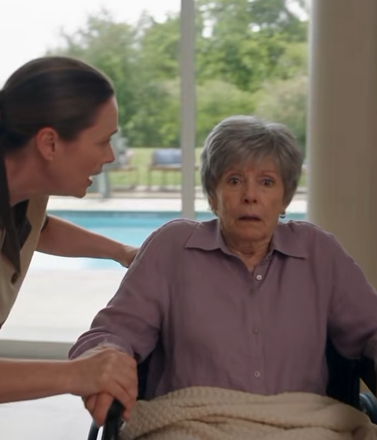
Seventy-eight-year-old Eleanor Harper sat in her wheelchair near the indoor garden room, not far from the pool.
Age had reduced her mobility, but not her awareness. Eleanor still noticed details others missed: a hesitation before an answer, a door closing too quickly, a conversation that stopped when she entered a room.
Her caregiver, Anna, noticed that Eleanor was unusually tense.
The older woman’s fingers were wrapped tightly around the armrests of her chair, and she kept glancing toward the corridor.
Anna approached her.
“Would you like me to take you somewhere quieter?”
Eleanor shook her head.
After several seconds, she whispered, “She’s here again.”
Anna followed her gaze.
“Who?”
Eleanor hesitated.
“The woman wearing blue.”
The hallway appeared empty.
Anna crouched beside her.
“Whatever is worrying you, you can tell me.”
Before Eleanor could answer, a sound came from behind them.
A door had closed.
Eleanor turned sharply.
Almost immediately, her wheelchair began moving.
Anna saw it rolling toward the pool and rushed forward. She caught the handles and brought the chair to a stop with several feet still separating Eleanor from the water.
For a moment, neither woman spoke.
Anna checked that Eleanor was secure.
“You’re all right. I’ve got you.”
Eleanor looked shaken.
Before Anna could ask what had caused the chair to move, footsteps approached from the hallway.
Eleanor’s son, Michael, entered first.
His wife, Claire, followed him wearing a dark blue dress. Their teenage son, Noah, was a few steps behind.
Michael immediately noticed his mother’s expression.
“What happened?”
Anna explained that the wheelchair had unexpectedly started rolling and that she had stopped it.
Claire’s reaction came quickly.
“How does a wheelchair simply start moving?”
Anna looked at her.
“I don’t know yet.”
“You were standing behind her.”
“I was helping her.”
Claire insisted that Anna must have been careless.
Michael interrupted before the argument could escalate.
“Nobody is accusing anyone until we understand what happened.”
He turned toward his mother.
“Mom, did you feel the chair move?”
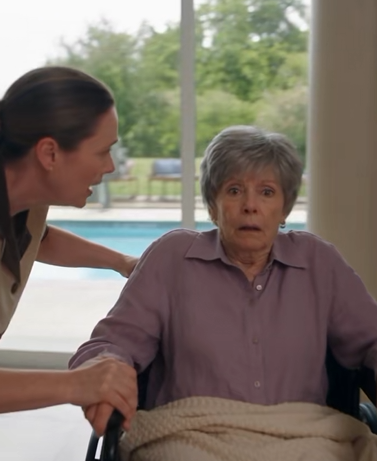
Eleanor looked from Michael to Claire.
Her lips parted, but she said nothing.
Noah, meanwhile, was staring at the television near the fireplace.
The screen was connected to the home’s security system.
“Dad, wouldn’t the camera have recorded this area?”
Everyone became quiet.
Michael looked toward the small camera mounted near the corridor.
“Check it.”
Noah opened the recent recording.
They watched Eleanor sitting alone.
Then another figure entered the frame.
Claire.
The recording showed her approaching the wheelchair while Eleanor was distracted. She bent beside it briefly and appeared to interfere with part of the chair before leaving the area.
The camera angle did not capture every detail, and Michael refused to jump to conclusions about exactly what had been done.
But one thing was clear.
Anna had not caused the incident.
Michael slowly faced his wife.
“Claire, what were you doing?”
She said nothing.
Anna looked at Eleanor.
The older woman lowered her eyes.
Michael’s voice became quieter.
“Please tell me what’s going on.”
Claire finally sat down.
“I was angry.”
“About what?”
She looked toward Eleanor.
“She was going to tell you.”
Michael frowned.
“Tell me what?”
Claire remained silent for several seconds.
“About your father’s trust.”
That answer changed the atmosphere in the room.
Years earlier, Michael’s late father had established a substantial family trust. Michael knew it existed, but he had never been involved in its detailed administration. Eleanor had retained authority over important decisions connected to it.
Claire had recently learned more about the arrangement and had begun imagining what it might eventually mean for her family’s future.
Eleanor knew that.
More importantly, she knew Claire had misunderstood why the trust existed.
“My husband didn’t spend his life building that fund simply so the next generation could divide it,” Eleanor said.
Michael turned to her.
“Then what was his plan?”
Eleanor looked toward the study at the opposite end of the house.
“He wanted this family to do something useful with what we were given.”
Anna hesitated before speaking.
“There may be something you should see.”
Several weeks earlier, while helping Eleanor organize personal papers at Eleanor’s request, Anna had come across a sealed envelope among documents intended for the family.
She retrieved it and handed it to Eleanor.
Eleanor nodded.
“Give it to Michael.”
Inside was a letter from Michael’s father.
The document explained that the family’s assets had been organized with safeguards designed to protect Eleanor’s independence and ensure that important decisions could not be made through pressure or intimidation.
It also described a charitable purpose that Michael had never known about.
His father had envisioned a future in which their enormous home would no longer belong to one family.
Michael read the relevant section twice.
“He wanted to give away the mansion?”
“Not exactly,” Eleanor replied.
She looked around the room.
“He wanted it to become useful.”
The original idea was to transform the property into a residential and support center for older adults who lacked dependable family assistance.
The trust would help fund the project when Eleanor decided the time was right.
Claire stared at the floor.
“I thought all of this was about what would eventually belong to us.”
Eleanor’s expression was sad rather than angry.
“That’s exactly what frightened me.”
Claire wiped her eyes.
“I made a terrible decision.”
“No one here is going to pretend otherwise,” Eleanor replied.
The room became silent.
Then Noah spoke.
“There’s another recording.”
He had discovered an older video stored separately in the family archive.
With Eleanor’s permission, he opened it.
Michael immediately recognized the man on the screen.
His father.
The recording had been made years earlier in the study.
The older man explained that he knew his family might someday measure his legacy in property, investments, and inheritance.
He hoped they would eventually understand that those things were only tools.
What mattered was what they chose to do with them.
He spoke about loneliness among older people who had lost spouses, relatives, mobility, or financial independence. He wanted the Harper property to become a place where some of them could live with companionship and dignity.
Then he explained why Eleanor had been given the final decision.
He trusted her to recognize when the family was ready.
The video ended.
For a long time, nobody moved.
Michael finally looked at his mother.
“Were you planning to do this?”
Eleanor nodded.
“I was waiting.”
“For what?”
“For this family to stop seeing the house as something we were entitled to keep.”
Claire began crying quietly.
“I nearly destroyed everything.”
Eleanor studied her for a moment.
“What happened today cannot simply be erased.”
Claire nodded.
“I understand.”
“Trust doesn’t return because someone says they’re sorry.”
“I know.”
Eleanor continued.
“But what you do next still matters.”
There was no sudden reconciliation.
Michael made sure the wheelchair and the circumstances surrounding the incident were properly reviewed, while the family took appropriate steps to protect Eleanor and establish clear boundaries. Claire had to accept responsibility for her actions and the consequences that followed.
Anna remained Eleanor’s caregiver.
Most importantly, decisions concerning Eleanor’s safety and finances were handled with greater transparency and independent oversight.
Over the following months, another change began.
The Harper residence was gradually redesigned.
The chandeliers remained.
So did much of the marble and the garden.
But private rooms became comfortable residential spaces. Other areas were converted for rehabilitation, activities, reading, meals, and visits with family members.
The house slowly filled with people.
Some residents arrived carrying only a suitcase.
Others brought boxes of photographs, favorite books, old records, or small objects collected over a lifetime.
Anna eventually became part of the center’s senior care team.
Michael helped oversee the property’s transition and the charitable organization responsible for it.
Noah volunteered whenever school allowed.
Claire’s future within the family was more complicated.
Forgiveness was not automatic, and her actions were not treated as though they had never happened.
Over time, however, she began contributing without asking for control or recognition. She helped with activities, spent time reading with residents, and learned to listen to people whose lives were very different from her own.
Nearly a year after the afternoon by the pool, Eleanor returned to the same room.
Her wheelchair was positioned safely beside the large windows, well away from the water.
The building sounded different now.
Someone was playing piano in another room.
Two residents were arguing cheerfully over a card game.
A group of visitors crossed the garden outside.
Noah came and sat beside his grandmother.
“Do you still think about what happened here?”
“Sometimes.”
“Does it scare you?”
Eleanor considered her answer.
“What happened frightened me. But I don’t want fear to be the only thing I remember.”
Noah looked around.
“What do you want to remember instead?”
Eleanor reached into the small bag attached to her chair and removed an old photograph.
It showed her and her husband standing outside the mansion when they were much younger.
Noah turned it over.
On the back, her husband had written a short note about a home’s true value coming from the care it could provide.
Noah smiled.
“Is this why you kept the mansion all these years?”
Eleanor looked toward the people filling what had once been a nearly silent house.
“I kept it because your grandfather believed it could become more than ours.”
Across the room, Anna was speaking with a new resident.
Michael was meeting with two members of the care staff.
Claire sat near a window, reading aloud to an elderly woman who had arrived only days earlier.
Noah handed the photograph back.
“So he was right.”
Eleanor smiled.
“About one thing, certainly.”
“What?”
She looked around the transformed house.
“Owning something valuable isn’t the same as giving it value.”
Noah leaned over and hugged her.
The family never erased the memory of that afternoon.
They didn’t turn it into a comforting story in which one apology repaired everything.
What happened had consequences.
But it also forced them to confront truths they had avoided for too long.
They could not rewrite the moment beside the pool.
They could decide what came after it.
And eventually, the mansion that had once been maintained as a monument to one family’s success became something entirely different:
a home where people who feared being forgotten could once again feel that they belonged.
